
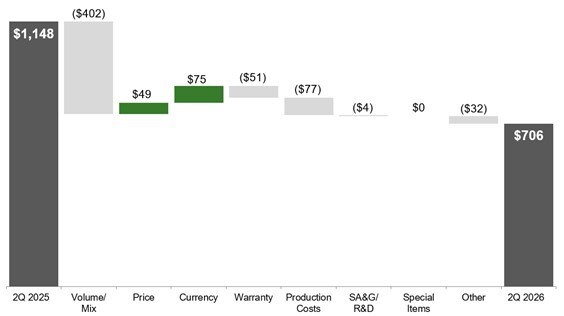
Deere & Company (NYSE: DE) reported second-quarter net income of $1.773 billion, or $6.55 per diluted share, for the period ended 3 May 2026, a decline of 1.7% from $1.804 billion, or $6.64 per share, recorded in the comparable quarter a year earlier. The Moline, Illinois-based manufacturer of agricultural and construction equipment said execution across its business segments drove what it characterised as solid performance, even as softer demand conditions weighed on year-over-year comparisons.
For the first six months of fiscal 2026, net income attributable to Deere fell to $2.429 billion, or $8.97 per share, from $2.673 billion, or $9.82 per share, in the same period of 2025 — a decline of approximately 9.1% and $244 million in absolute terms. The half-year result reflects a prolonged correction in global agricultural equipment markets, where elevated input costs and uncertain commodity price outlooks have prompted farmers in key regions to defer large capital purchases.
The agricultural machinery sector has faced mounting pressure through the first half of 2026 as grain prices retreated from post-pandemic highs and interest rates kept financing costs elevated for farm operators. Comparable headwinds have rippled through the broader food and agribusiness supply chain, constraining investment in precision-farming technology and large-acreage equipment that underpins productivity gains for commercial growers. Coverage of how those capex shifts are reshaping farm-to-processor economics is tracked in our supply-chain analysis and agribusiness markets sections.
Despite the earnings decline, Deere maintained its full-year net income guidance, a signal analysts typically interpret as management's view that the back half of the fiscal year will be sufficiently robust to offset first-half softness. The company cited continued investment in new products and technology as a foundation for long-term value creation, pointing to its precision-agriculture software stack and autonomous field equipment programme as growth drivers beyond the current demand trough.
For food and beverage industry participants whose operating costs are directly linked to agricultural output and mechanisation rates — including grain processors, protein producers, and large-scale ingredient buyers — Deere's maintained guidance suggests equipment-driven productivity improvements remain on track even if the delivery timeline has extended. Food & Beverage Magazine has separately noted that commodity buyers are watching farm-equipment utilisation data as a leading indicator of crop-year supply volumes.
Written by Michael Politz, Author of Guide to Restaurant Success: The Proven Process for Starting Any Restaurant Business From Scratch to Success (ISBN: 978-1-119-66896-1), Founder of Food & Beverage Magazine, the leading online magazine and resource in the industry. Designer of the Bluetooth logo and recognized in Entrepreneur Magazine's "Top 40 Under 40" for founding American Wholesale Floral, Politz is also the Co-founder of the Proof Awards and the CPG Awards and a partner in numerous consumer brands across the food and beverage sector.