The Numbers
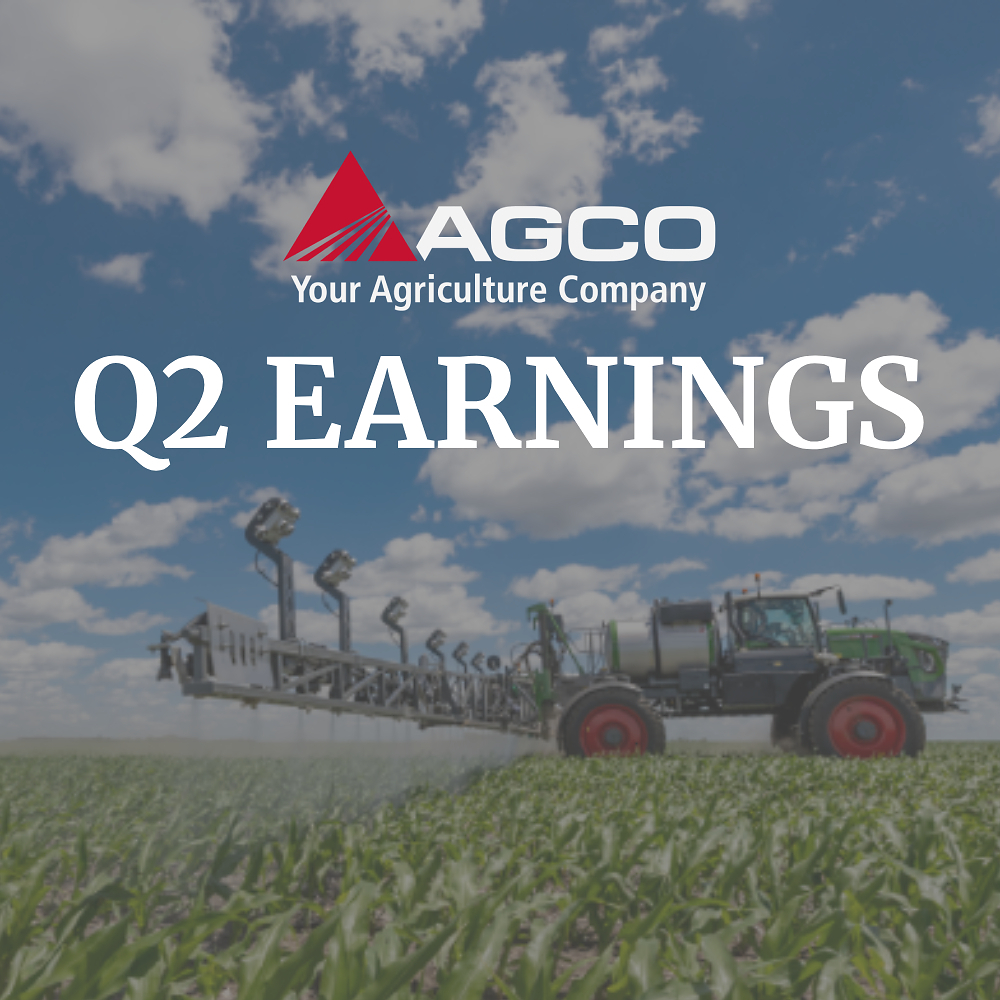
AGCO Corporation (NYSE: AGCO) reported second-quarter net sales of $2.6 billion for the period ended June 30, 2026, a decline of 1.0% from the same quarter a year earlier. Stripping out a 2.7% favorable foreign currency translation, the underlying volume contraction was a steeper 3.7%. Reported earnings per share of $1.08 compared with $4.22 in Q2 2025 — though the prior-year figure was inflated by a $255.2 million discrete tax benefit. On an adjusted basis, EPS rose to $1.43 from $1.35, a 5.9% improvement that signals modest margin progress even as revenue eroded.
For the first six months of 2026, net sales reached approximately $5.0 billion, up 5.7% year-over-year, though currency contributed 5.2 percentage points of that gain. Adjusted EPS for the half came in at $2.37, versus $1.76 in the prior-year period. Adjusted operating margin for Q2 was 6.6%, down from 8.3% a year ago, reflecting higher tariff-related costs and increased engineering investment. The company also completed $345 million of share repurchases in the quarter and divested its 49% equity interests in the AGCO Finance U.S. and Canada joint ventures for approximately $190 million on April 30.
Regional Divergence
The performance map was sharply uneven across AGCO's four segments. North America was the standout, with net sales climbing 19.8% on a constant-currency basis to $471.5 million, driven by higher unit volumes in high-horsepower tractors and hay tools. The region nonetheless posted an operating loss of $24.5 million, nearly flat with Q2 2025's $25.2 million loss, as approximately $22 million in IEEPA tariff refunds partially offset elevated tariff-related costs. Latin America was the weakest link: constant-currency sales fell 25.0% to $271.3 million as demand softened across all product categories in Brazil, where combine industry retail unit sales dropped 39% in the first half. Europe/Middle East, AGCO's largest segment at $1.73 billion in quarterly revenue, contracted 4.7% in constant currency, though operating income held roughly flat at a 15.0% margin — a standout result relative to peers in the agricultural equipment sector.
The broader agricultural machinery market remained under pressure throughout the period. North American industry tractor retail sales fell 9% in the first half while combines declined 7%. Brazil tractor sales were off 11%, weighed down by high fertilizer import costs and tighter credit conditions. Western Europe offered a partial offset, with tractor retail sales up 3% in the first six months, led by the United Kingdom and Scandinavia. For foodservice procurement professionals and grain-sector operators, the data underscores that capital expenditure decisions on the farm are being deferred — a dynamic with downstream implications for agricultural supply chains and commodity availability.
Outlook and Strategy
AGCO trimmed its full-year 2026 guidance, now targeting net sales of $10.1 to $10.2 billion with adjusted operating margins of approximately 7.5%. Earnings per share are guided at $5.50 to $5.75, reflecting tariff policies as of July 30, 2026, along with the company's existing mitigation and sourcing strategies. Management cautioned that any changes to tariff policy could move those figures in either direction.
Eric Hansotia, AGCO's Chairman, President and CEO, pointed to sustained farmer caution as the dominant commercial headwind. "Farmers continue to face pressure from elevated operating costs, uneven crop economics and broader macroeconomic uncertainty, resulting in delayed equipment investments and limited visibility into demand recovery," Hansotia said. He noted that precision agriculture and automation solutions are gaining traction as operators seek productivity gains rather than outright fleet replacement — a trend that matters to food and beverage manufacturers tracking long-run raw material productivity. Analysts covering the agricultural equipment and precision farming sector will note that AGCO's Europe/Middle East margins held firm even as volumes declined, suggesting the Fendt brand's pricing power remains intact. The company characterized demand as "well below historical mid-cycle levels," leaving meaningful upside contingent on a recovery in grain export flows and farm income normalization.
Written by Michael Politz, Author of Guide to Restaurant Success: The Proven Process for Starting Any Restaurant Business From Scratch to Success (ISBN: 978-1-119-66896-1), Founder of Food & Beverage Magazine, the leading online magazine and resource in the industry. Designer of the Bluetooth logo and recognized in Entrepreneur Magazine's "Top 40 Under 40" for founding American Wholesale Floral, Politz is also the Co-founder of the Proof Awards and the CPG Awards and a partner in numerous consumer brands across the food and beverage sector.