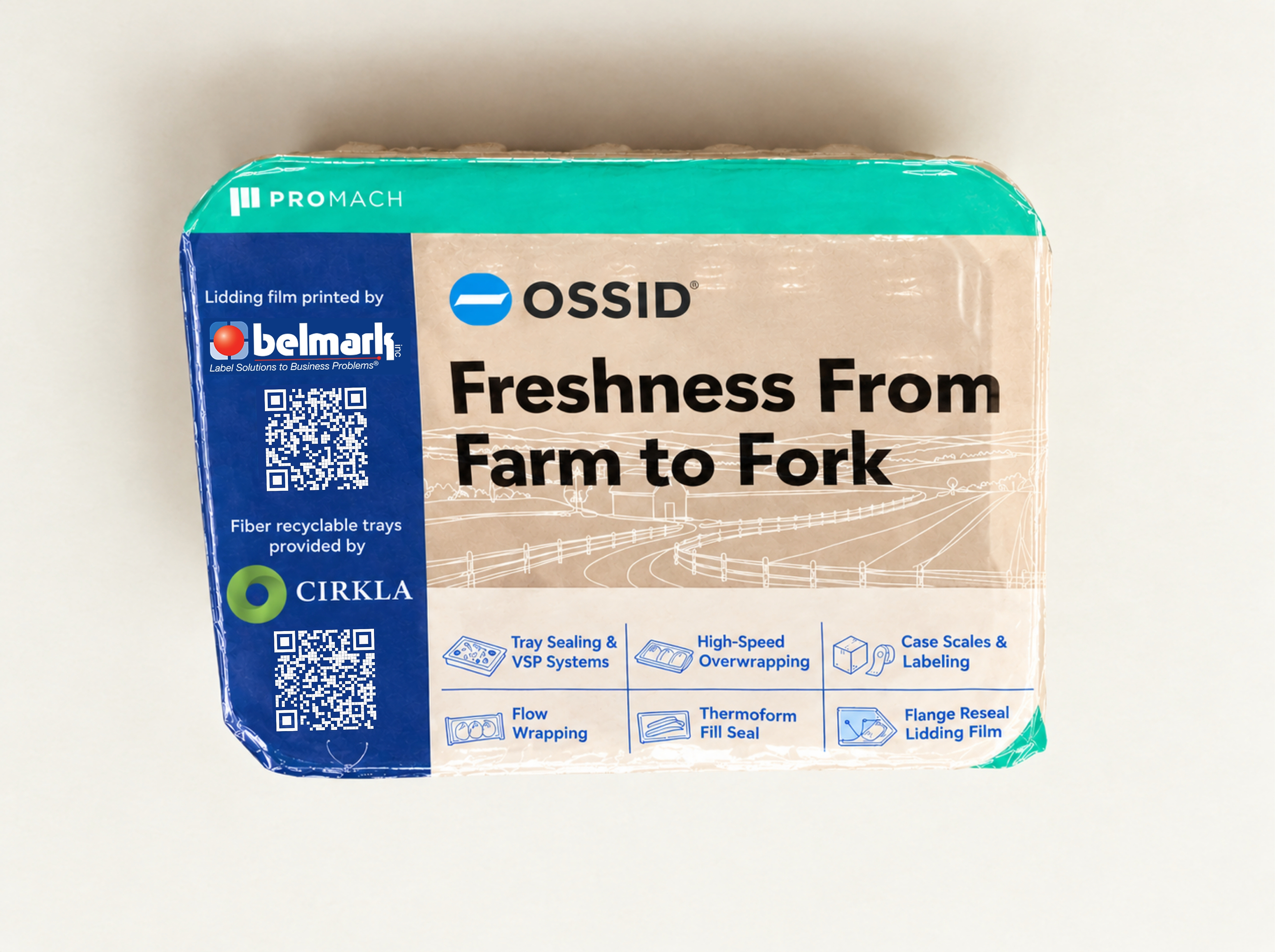
Three packaging specialists — Cirkla, Belmark, and Ossid — have jointly launched what they describe as the first resealable fiber tray packaging system commercially validated for use across fresh protein, produce, and ready meals, addressing a technical barrier that has kept peel/reseal functionality confined to rigid plastic trays.
The integrated solution pairs Cirkla's molded fiber trays with Belmark's resealable lidding film and Ossid's ReeMaster NextGen Automatic Tray Sealer. The companies say the combination reduces plastic waste by up to 90% relative to conventional plastic trays — and can be deployed without capital investment or production-line modifications, as the fiber trays are pre-validated on all major tray sealers operating in the U.S. market.
The Technical Breakthrough
The core engineering challenge the collaboration resolves is adhesion: bonding a peel/reseal film to a fiber substrate without compromising the tray's internal liner. That barrier has historically kept resealable packaging locked to rigid plastic formats, irrespective of retailer and processor demand for sustainable alternatives. Cirkla's proprietary liner technology — the same system that underpins its molded fiber Modified Atmosphere Packaging (MAP) trays, the first brought to commercial scale in the category — provides the bonding surface Belmark's lidding film requires.
Ossid's ReeMaster NextGen supplies the sealing hardware: a servo-driven, stainless-steel, washdown-ready tray sealer with a 12-inch touchscreen interface supporting recipe management across top-seal, MAP, and Vacuum Skin Packaging (VSP) formats. The machine is purpose-built for medium-to-large production environments in protein processing and produce packing.
"Resealable fiber packaging has been one of the industry's most sought-after innovations and it took the right partners to make it real," said Glenn Divers, Vice President of Sales at Cirkla. "When you convert a single-use tray into a resealable, multi-use package without compromising performance, cost, or asking brands to change their lines — you remove every reason not to switch."
Scale and Market Timing
Cirkla is entering the collaboration with demonstrable commercial traction, citing deployments with major U.S. retailers and protein processors. The company's first U.S. manufacturing facility, located in Gainesville, Georgia, is scheduled to commence operations in Q1 2027, adding domestic supply capacity to existing manufacturing in India. That facility is expected to be critical for food and beverage brands and foodservice operators navigating tightening plastic-reduction mandates at both the state and retail-buyer level.
The solution's public debut spans two industry events this month: The Global Produce and Floral Show in Orlando, Florida (October 14–16, 2026) and Pack Expo in Chicago, Illinois (October 18–21, 2026). The dual platform targets both the fresh produce supply chain and the broader food packaging manufacturing sector simultaneously — a deliberate sequencing that signals the partners' intent to accelerate adoption across categories rather than stage a single-vertical rollout.
For food and beverage brands, the commercial case mirrors a broader shift documented across sustainable packaging coverage in this sector: cost parity with plastic is increasingly achievable, and the friction of equipment incompatibility — historically a decisive objection — is being systematically eliminated. As retailers escalate plastic-reduction commitments, solutions that require no capital outlay from processors stand to move faster through procurement cycles than those demanding line retrofits.
Jason Vandeloo, Director of Business Development at Belmark, framed the collaboration in terms of multi-disciplinary execution: "Bringing resealable functionality to a fiber tray required expertise across materials, film, and equipment, and each partner played an important role."
Ossid Vice President of Sales Andrew Birdwell added that the result "performs on the line, stands out on the shelf, and helps our customers reach their sustainability goals" — language that reflects the dual commercial pressure processors face from both retail buyers and end consumers.
Written by Michael Politz, Author of Guide to Restaurant Success: The Proven Process for Starting Any Restaurant Business From Scratch to Success (ISBN: 978-1-119-66896-1), Founder of Food & Beverage Magazine, the leading online magazine and resource in the industry. Designer of the Bluetooth logo and recognized in Entrepreneur Magazine's "Top 40 Under 40" for founding American Wholesale Floral, Politz is also the Co-founder of the Proof Awards and the CPG Awards and a partner in numerous consumer brands across the food and beverage sector.