Deere & Company (NYSE: DE) reported fiscal-year 2026 net income of $4.860 billion, or $17.95 per diluted share, down from $5.027 billion, or $18.50 per share, in fiscal 2025 — a 3.3% decline that reflects continued pressure on large-agriculture shipment volumes across its core equipment segments.
Full-year net sales rose 6.1% to $41.292 billion from $38.917 billion in fiscal 2025, as strength in Small Agriculture & Turf and Construction & Forestry offset a 9.4% drop in Production & Precision Agriculture net sales to $15.682 billion. Worldwide net sales and revenues, including financial services, reached $47.704 billion for the year, a 4.4% gain.
Q4 Segment Divergence
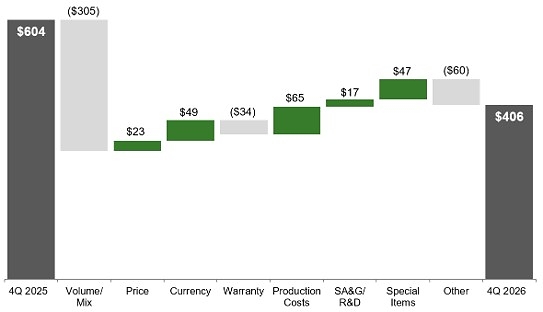
Fourth-quarter results highlighted a sharp divergence across Deere's business lines. Production & Precision Agriculture net sales fell 15.3% year over year to $4.018 billion, with operating profit dropping 32.8% to $406 million and operating margin compressing to 10.1% from 12.7%. The segment, which supplies large tractors and combines critical to row-crop farming, was hit by lower shipment volumes and an adverse sales mix. For food and agribusiness supply-chain operators, the segment's recovery trajectory carries direct implications for precision-farming technology adoption, crop yield optimization, and ultimately commodity production capacity in North America and globally.
By contrast, Small Agriculture & Turf delivered a standout quarter: net sales rose 10.0% to $2.703 billion and operating profit surged to $233 million from just $25 million a year earlier — an 832% jump — lifting operating margin to 8.6% from 1.0%. Lower warranty costs, reduced production expenses, and favorable price realization all contributed. Construction & Forestry net sales climbed 12.2% to $3.793 billion, though operating margin slipped to 8.9% from 10.3% as higher production and R&D costs absorbed the revenue gain. Financial Services net income declined 21.1% to $231 million, pressured by unfavorable financing spreads and a higher provision for credit losses.
Deere also recorded $383 million in tariff recoveries during fiscal 2026, underscoring the ongoing cost complexity operators face in a volatile trade environment. For agri-food supply chains that rely on Deere equipment financing through dealer networks, the tighter Financial Services margins signal incrementally higher borrowing costs ahead. The company completed several technology-focused acquisitions during the year, including the $439 million purchase of Tenna LLC, a construction asset-tracking platform, as part of its broader push into precision agriculture and digital fleet management — capabilities with growing relevance for large-scale foodservice and crop-input operators who depend on harvest-equipment utilization data.
Fiscal 2027 Guidance
John May, chairman and chief executive officer of Deere & Company, said the company enters fiscal 2027 seeing "early signs of improvement in large agriculture, led by North America" but acknowledged "continued uncertainty in key end markets" justifies a wider guidance range. The company projects fiscal 2027 net income of $4.50 to $5.25 billion. That range includes an estimated one-time, non-cash pension settlement charge of $0.25 to $0.40 billion associated with a voluntary lump-sum payment option for certain U.S. salaried retirees.
By segment, Deere expects Production & Precision Agriculture net sales to rise 5% to 15% in fiscal 2027, with approximately 3.0% favorable price realization partially offset by a 1.5% currency translation headwind. Small Agriculture & Turf net sales are expected to remain roughly flat, while Construction & Forestry is guided flat to up 10%. For global agricultural markets, the company's industry outlook calls for U.S. and Canadian large-ag industry volumes up 5% to 15%, European ag flat to down 5%, South American tractors and combines flat to up 5%, and Asian markets approximately flat — a geographic mosaic that reflects divergent farm-income conditions and food-commodity price signals across producing regions. Financial Services net income is targeted at approximately $0.90 billion for fiscal 2027.
For food and beverage industry participants tracking upstream agricultural capacity — from grain origination and oilseed processing to protein supply chains — Deere's outlook reinforces a view that the global large-equipment replacement cycle is in early-stage recovery rather than expansion, with capital discipline by growers likely to constrain rapid step-ups in planting technology and precision-agriculture adoption through at least mid-fiscal 2027.
Written by Michael Politz, Author of Guide to Restaurant Success: The Proven Process for Starting Any Restaurant Business From Scratch to Success (ISBN: 978-1-119-66896-1), Founder of Food & Beverage Magazine, the leading online magazine and resource in the industry. Designer of the Bluetooth logo and recognized in Entrepreneur Magazine's "Top 40 Under 40" for founding American Wholesale Floral, Politz is also the Co-founder of the Proof Awards and the CPG Awards and a partner in numerous consumer brands across the food and beverage sector.