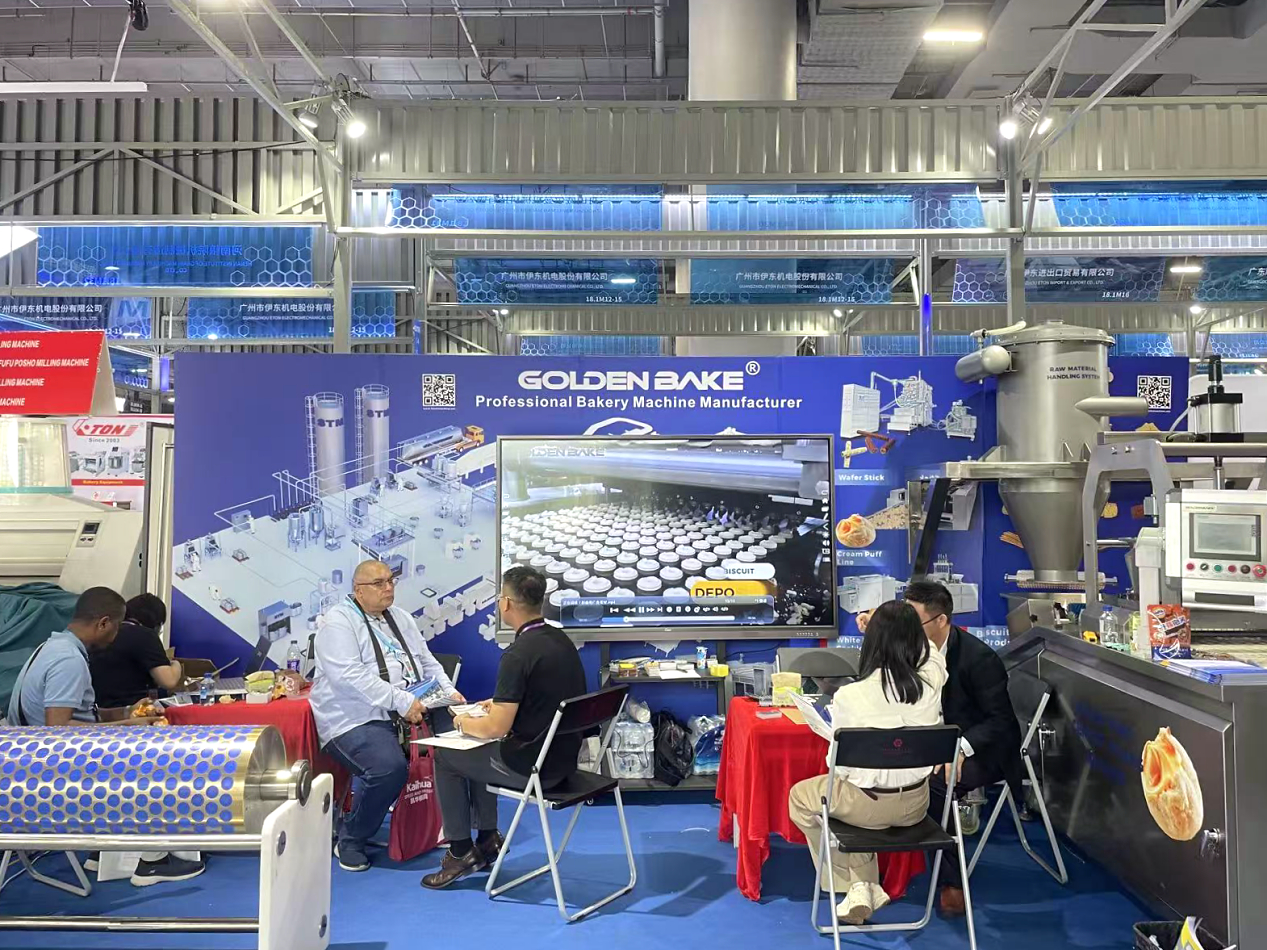
Golden Bake, the baking equipment division of Evergrowing Machinery Company Limited, used the 140th Canton Fair to showcase an end-to-end ingredient-automation platform for industrial biscuit production — combining pneumatic flour conveying, precision dosing, and PLC-controlled scheduling in a single integrated line.
The announcement lands as capital spending across industrial bakeries tilts sharply toward precision and consistency. A 2025–26 survey cited by Baking Business found 59% of respondents naming quality, consistency, and precision as key investment objectives for 2026, while 32% are prioritising retrofits and upgrades and 22% plan to add new lines or equipment entirely.
Dust and Dosing
The system addresses two persistent pain points in high-volume biscuit manufacturing: airborne flour dust and weighing variance. Golden Bake's feeding station combines bag-emptying, 30-mesh sifting, and dual-suction negative-pressure dust extraction capable of processing up to 50 kilograms of flour per minute. A pulse-cleaned cartridge separator fitted with food-grade anti-static filter media and a rotary valve at the hopper base handles the separation step. Pneumatic conveying then moves flour through sealed pipes to a 1,000-kilogram buffer hopper, where gravity separation and intermittent agitation prevent bridging. The electrical and powder-handling design complies with Chinese explosion-proof standards GB 50058-2014 and AQ 3009-2007 — relevant given that the U.S. Occupational Safety and Health Administration classifies flour as a flammable dust capable of causing an explosion under certain conditions.
On dosing precision, a Golden Bake food technologist quoted at the fair noted that even a small shift in flour ratios can alter water absorption, dough strength, and forming performance — defects that manifest quickly at scale as biscuit thickness and texture inconsistencies. The company's automatic weighing hopper, also rated at 1,000 kilograms, completes a full weighing cycle for a two-flour recipe in approximately three minutes, with a tested tolerance of ±200 grams. Ingredient ratios, weighing data, and recipe records are stored digitally, reducing exposure to operator turnover and simplifying product changeovers.
Line-Wide Scheduling
Beyond ingredient handling, the platform uses PLC-controlled scheduling to coordinate sugar milling, additive metering, and parallel liquid dosing — pumping oils, water, and other liquids into the mixer simultaneously to narrow the idle gaps that stall downstream forming and baking. Golden Bake's marketing manager framed the value proposition plainly at the fair: the goal is to cut flour dust exposure and weighing errors at the source while keeping production throughput steady.
Configuration flexibility is central to the commercial pitch. The modular feeding system can be integrated into existing biscuit lines depending on plant layout, addressing the large retrofit segment. For greenfield projects, the company offers turnkey biscuit factory solutions spanning facility planning, equipment layout, manufacturing, installation, and commissioning. Product-specific variations — such as cookie lines that sequence sugar, fat, and flour differently, or cracker lines requiring staged mixing and fermentation — are accommodated through recipe-level customisation.
Global Footprint
Founded in 1999, Golden Bake has installed more than 3,500 production lines across more than 30 countries and regions and holds long-term supply relationships with several large overseas food enterprises. The Canton Fair showcase, which paired the ingredient-handling 3D model with a multifunction cookies machine and a cream puff production line, is part of a broader push to expand the company's global service network as biscuit manufacturers invest in automation and digital controls to improve overall equipment effectiveness.
For food and beverage manufacturers evaluating automation investment across processing categories, the Golden Bake system illustrates a wider shift: ingredient preparation — long treated as a pre-process afterthought — is increasingly being brought inside the control architecture of the main production line. Operators weighing capital expenditure options in baked goods and snack manufacturing will find the retrofit-versus-greenfield calculus central to vendor conversations in 2026 and beyond.
Written by Michael Politz, Author of Guide to Restaurant Success: The Proven Process for Starting Any Restaurant Business From Scratch to Success (ISBN: 978-1-119-66896-1), Founder of Food & Beverage Magazine, the leading online magazine and resource in the industry. Designer of the Bluetooth logo and recognized in Entrepreneur Magazine's "Top 40 Under 40" for founding American Wholesale Floral, Politz is also the Co-founder of the Proof Awards and the CPG Awards and a partner in numerous consumer brands across the food and beverage sector.