The Launch
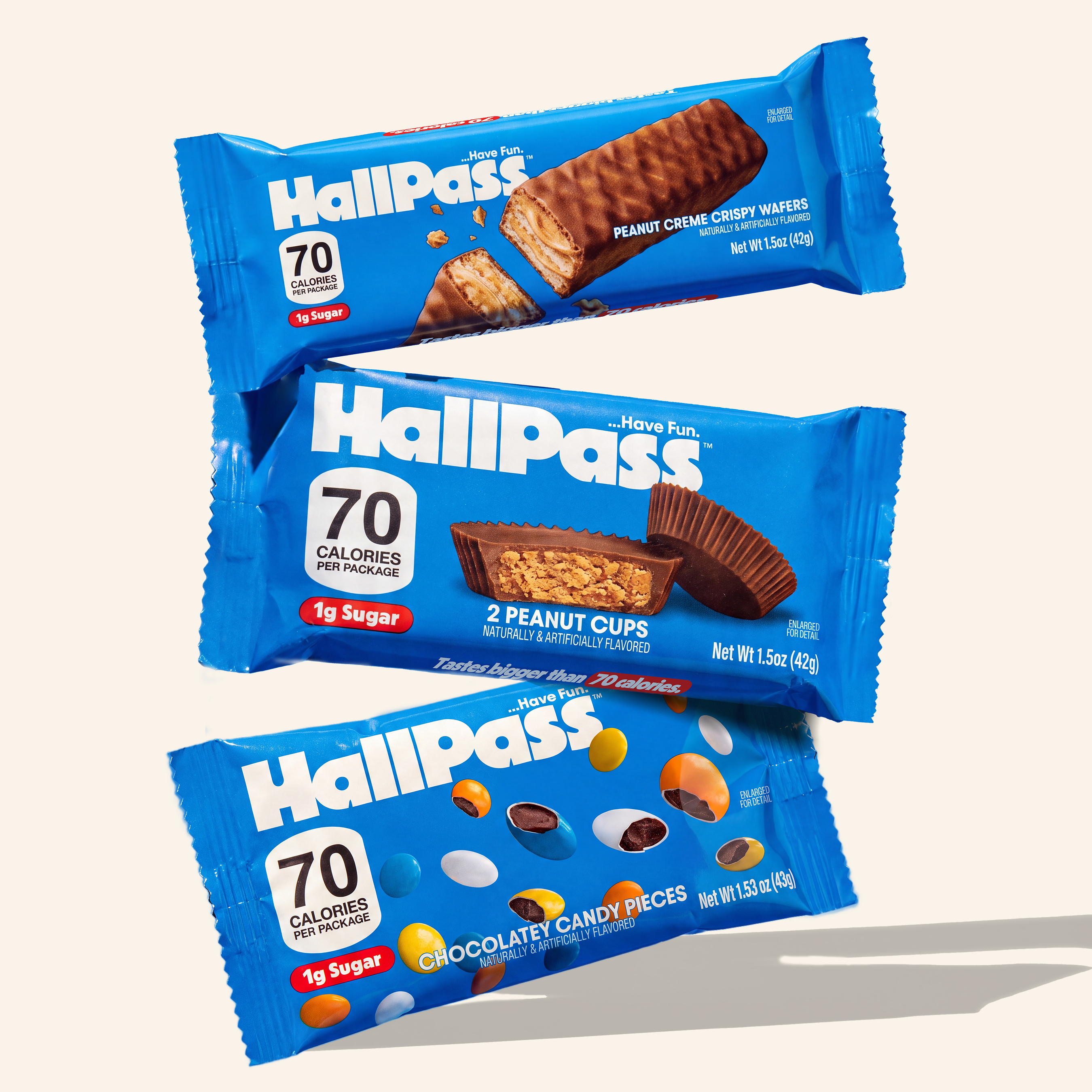
HallPass, a new confectionery brand from Medici Brands co-founders Peter Rahal and Michael Tierney, began selling at Walmart stores nationwide and on Walmart.com on August 30, 2026 — entering mass retail on day one with three distinct SKUs and a nutritional profile its backers say is unmatched in the candy aisle.
The debut lineup spans Peanut Cups, Peanut Creme Crispy Wafers, and Chocolatey Candy Pieces. Each product delivers 70 calories and 1g of sugar per serving, benchmarks the founders are positioning as a structural break from conventional candy rather than an incremental reformulation.
The Pricing Argument
The strategic logic centres on price parity. Competing better-for-you confectionery products have historically commanded a significant premium over mainstream candy brands — a friction point the founders argue has constrained category growth. HallPass is priced in line with legacy candy, a decision Tierney frames as central to the brand's long-term retail viability.
"You don't pay more for Coke Zero than classic Coke, but somehow all low-sugar and low-calorie candies charge a multiple of the national brands," said Michael Tierney, Co-Founder of HallPass. "That needed to change."
The analogy to Coke Zero is deliberate: Rahal and Tierney built HallPass around the thesis that the soda category's better-for-you pivot — which reshaped shelf sets and consumer behavior over two decades — has yet to find its equivalent in confectionery. The Diet Coke and Coke Zero playbook, they contend, is directionally applicable to candy, where household-name products still dominate and reduced-calorie alternatives hold a fraction of category volume.
Market Context
The timing reflects broader pressure on the confectionery segment. U.S. candy retail sales have remained resilient, but consumer research consistently shows elevated sensitivity to sugar content and calorie density, accelerated in part by the growing penetration of GLP-1 weight-loss medications reshaping snacking occasions. Better-for-you positioning in adjacent categories — protein bars, snack chips, carbonated soft drinks — has demonstrated that reformulated products can capture durable market share when the taste gap is closed and the price delta is eliminated.
HallPass is the second brand under Medici Brands, alongside David Protein, a high-protein bar that built distribution in specialty and convenience channels before moving to mass retail. That playbook — product credibility first, then broad distribution — appears to be running in reverse for HallPass, which is opening directly in Walmart's full national footprint. The mass-first approach signals confidence in the product's mainstream appeal and suggests the founders are prioritizing scale over niche-channel cultivation. For Walmart, the listing adds a differentiated better-for-you confectionery option at a moment when the retailer has been actively expanding its better-for-you snack assortment.
The confectionery market's incumbent brands — including Mars, Mondelēz, and Hershey — have pursued their own reduced-sugar and permissible-indulgence lines in recent years, though none has fully replicated the soda category's success in normalizing zero-sugar formats at price parity. HallPass will need to compete not only against those iterations but also against a crowded field of startup confectionery brands that have similarly targeted the better-for-you candy segment with limited mass-retail traction.
Written by Michael Politz, Author of Guide to Restaurant Success: The Proven Process for Starting Any Restaurant Business From Scratch to Success (ISBN: 978-1-119-66896-1), Founder of Food & Beverage Magazine, the leading online magazine and resource in the industry. Designer of the Bluetooth logo and recognized in Entrepreneur Magazine's "Top 40 Under 40" for founding American Wholesale Floral, Politz is also the Co-founder of the Proof Awards and the CPG Awards and a partner in numerous consumer brands across the food and beverage sector.