
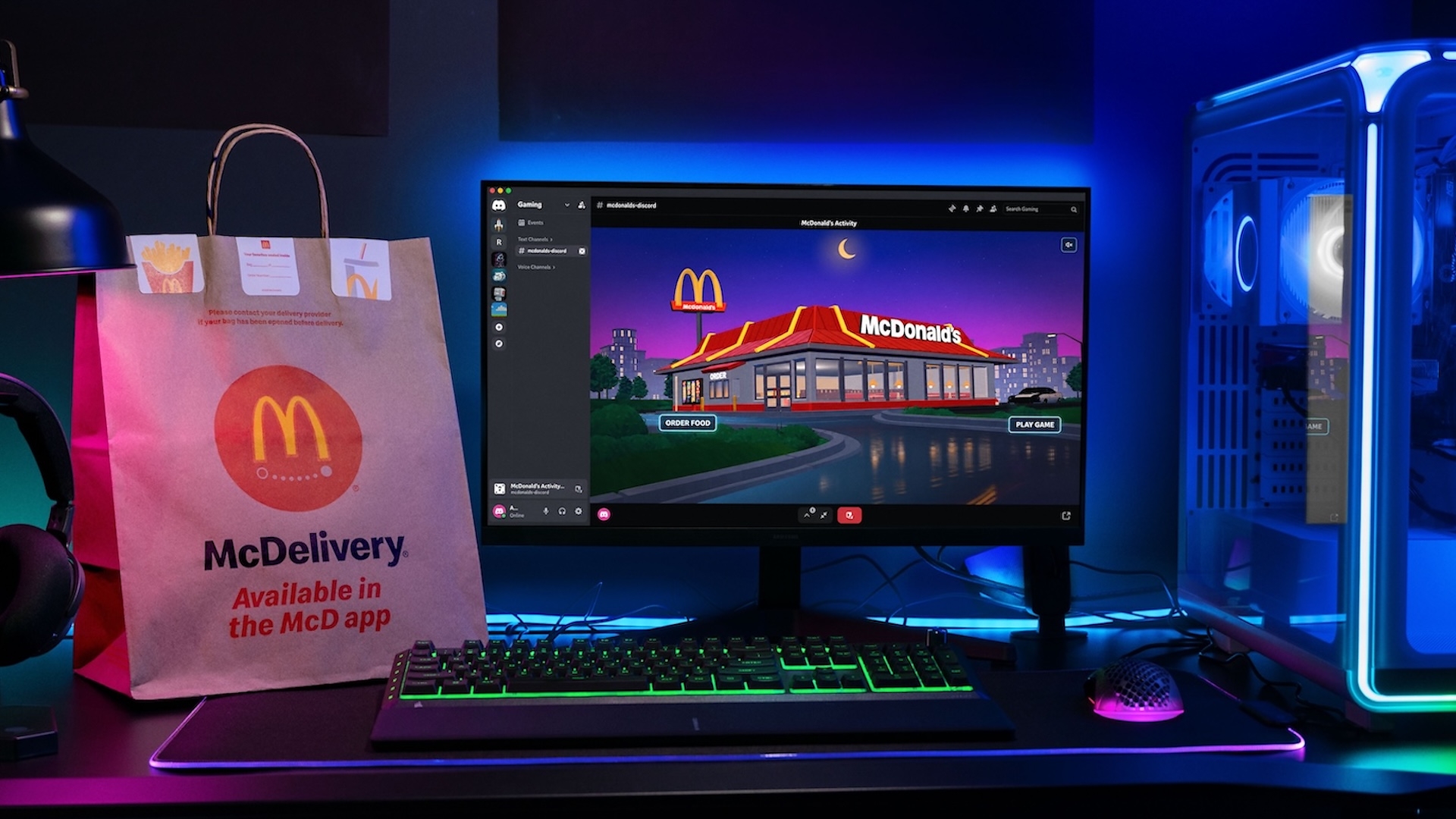
McDonald's USA, LLC has embedded a native ordering tool inside Discord, enabling users to place McDelivery orders through Uber Eats without leaving the gaming communication platform. The move marks one of the first integrations of a quick-service restaurant's delivery workflow directly into a gaming-oriented social app, arriving timed to what the chain described as the biggest video game release of the decade.
How the Integration Works
Users access the feature by launching the "Order McDonald's" activity from Discord's Apps & Activities menu. From there, the flow connects to Uber Eats for order placement and fulfillment. The integration keeps the entire transaction inside Discord's interface, eliminating the friction of switching applications — a friction point the chain is explicitly betting reduces cart abandonment among gaming-session users. While waiting for delivery, users can also play Fast Lane Feast, a Discord-exclusive mini-game in which players collect burgers and fries and compete on a leaderboard.
Why It Matters for QSR
For the quick-service restaurant sector, the Discord partnership represents a channel-extension strategy that goes beyond conventional app-based or social-media ordering. Discord reported more than 200 million monthly active users globally as of its most recent public disclosures, with a user base skewed toward younger, digitally engaged consumers — a cohort QSR chains have aggressively targeted through loyalty programs, limited-time offers, and influencer campaigns. By placing a transactional touchpoint inside a platform where users already spend extended sessions, McDonald's is effectively reducing the distance between intent and purchase in an environment where food delivery demand tends to spike during evening and late-night hours.
The Uber Eats routing also reinforces the chain's existing third-party delivery infrastructure rather than requiring a separate fulfillment build. Approximately 13,500 U.S. McDonald's locations — representing roughly 95% of the domestic footprint — are owned and operated by independent franchisees, meaning delivery availability will vary by market based on franchisee participation and Uber Eats coverage.
The Discord activation fits a broader pattern in foodservice of brands chasing consumer attention in non-traditional digital environments. Competitors including Wendy's and Taco Bell have previously experimented with gaming-platform partnerships and in-game promotions, though embedded transactional activities of this type remain relatively uncommon in the category. As delivery economics tighten and third-party platforms compete for restaurant partners, integrations that drive incremental order volume — without requiring dedicated media spend per transaction — carry meaningful unit-economics appeal for both the operator and the delivery aggregator.
For retail and foodservice analysts tracking delivery channel trends, the McDonald's-Discord integration offers an early data point on whether ambient-platform ordering converts at meaningful rates compared with direct app or website orders. For franchisees, the question will be whether the incremental order volume justifies Uber Eats' commission structure — a tension that has shaped QSR delivery strategy across the industry since third-party platforms scaled rapidly post-pandemic.
Written by Michael Politz, Author of Guide to Restaurant Success: The Proven Process for Starting Any Restaurant Business From Scratch to Success (ISBN: 978-1-119-66896-1), Founder of Food & Beverage Magazine, the leading online magazine and resource in the industry. Designer of the Bluetooth logo and recognized in Entrepreneur Magazine's "Top 40 Under 40" for founding American Wholesale Floral, Politz is also the Co-founder of the Proof Awards and the CPG Awards and a partner in numerous consumer brands across the food and beverage sector.