
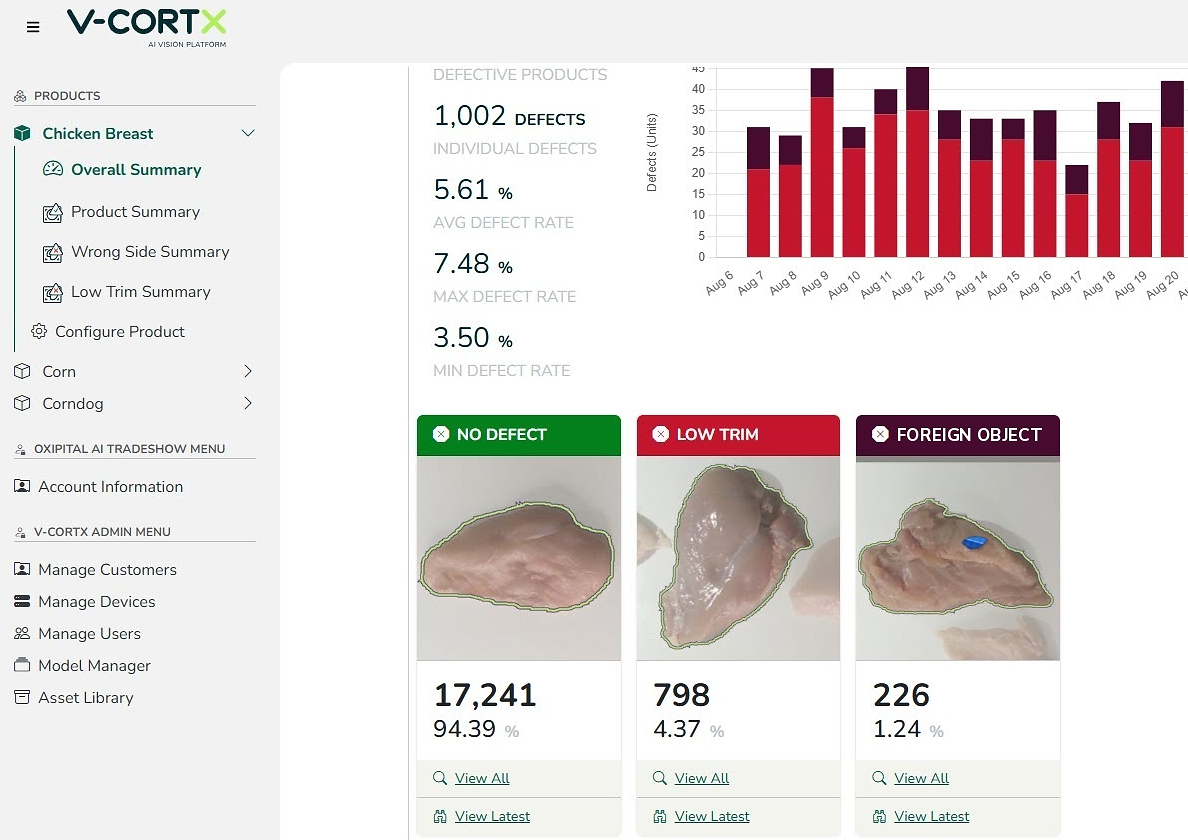
Oxipital AI launched a Foreign Material Detection capability on October 16 designed to identify contaminants on high-speed food production lines in real time, the company announced at Pack Expo in Chicago. The system claims detection accuracy of up to 99% at production line speed, covering hard and soft plastics, wood chips, metal shards, bone fragments, cardboard, and partial or full personal protective equipment.
The capability runs on the OX and VX hardware platforms already deployed by food manufacturers for quality inspection and vision-guided robotics — positions Oxipital AI as a single-vendor solution for inspection, safety, and automation. The company said the product is live in production environments today, not in pilot.
How the System Works
Rather than relying on contamination events to build training data, Oxipital AI uses synthetic data generation to model the visual signatures of common foreign materials across varied lighting conditions, product types, and line speeds. That approach is intended to make models production-ready from day one, reducing the calibration lag that typically accompanies new inspection deployments.
When a contaminant is detected, the platform's V-CORTX software layer classifies it by severity and triggers an automated line response — slowing the line for minor anomalies, stopping it outright for high-severity events — without manual intervention. The system also identifies contaminant type, not just presence, giving quality assurance teams traceability data to determine whether a foreign material originated from a worn line component, a supplier input, or a changeover gap.
Audit Trail and Analytics
Every detection event is automatically logged in the V-CORTX analytics dashboard with a timestamp, classification, imagery, dimensional data, and throughput impact. The continuous, searchable record is designed to support FSQA documentation and root-cause analysis, two areas of increasing regulatory scrutiny under the FDA's Food Safety Modernization Act framework.
"What we kept hearing from customers was that they needed a single platform that could handle quality, robotics, and food safety without adding complexity," said Mark Chiappetta, Chief Executive Officer of Oxipital AI. "Our customers told us they wanted fewer vendors, fewer integration headaches, and more confidence in what their inspection system could catch."
Market Context
Foreign material contamination remains one of the leading drivers of Class I and Class II food recalls in the United States. For large-scale protein and packaged-goods producers, a single recall event can cost tens of millions of dollars in product write-offs, regulatory penalties, and reputational damage. The push toward AI-powered vision inspection — rather than traditional X-ray or metal-detector-only approaches — reflects a broader capital investment trend in food manufacturing automation as processors seek to reduce human inspection variability and improve recall-prevention metrics.
Oxipital AI was spun out of robotics firm Soft Robotics and counts some of the world's largest food producers among its installed base, according to the company. Foreign Material Detection joins quality inspection and vision-guided robotics as the third pillar of its unified platform, a consolidation pitch that mirrors a wider vendor-rationalization trend among food safety technology buyers.
The system is on live demonstration at Pack Expo at booth S-3192 through October 21. As noted by the company, vision-based inspection is limited to material that is visible to the camera at operating line speed; items too small to resolve or outside the camera's field of view may not be detected.
Written by Michael Politz, Author of Guide to Restaurant Success: The Proven Process for Starting Any Restaurant Business From Scratch to Success (ISBN: 978-1-119-66896-1), Founder of Food & Beverage Magazine, the leading online magazine and resource in the industry. Designer of the Bluetooth logo and recognized in Entrepreneur Magazine's "Top 40 Under 40" for founding American Wholesale Floral, Politz is also the Co-founder of the Proof Awards and the CPG Awards and a partner in numerous consumer brands across the food and beverage sector.