
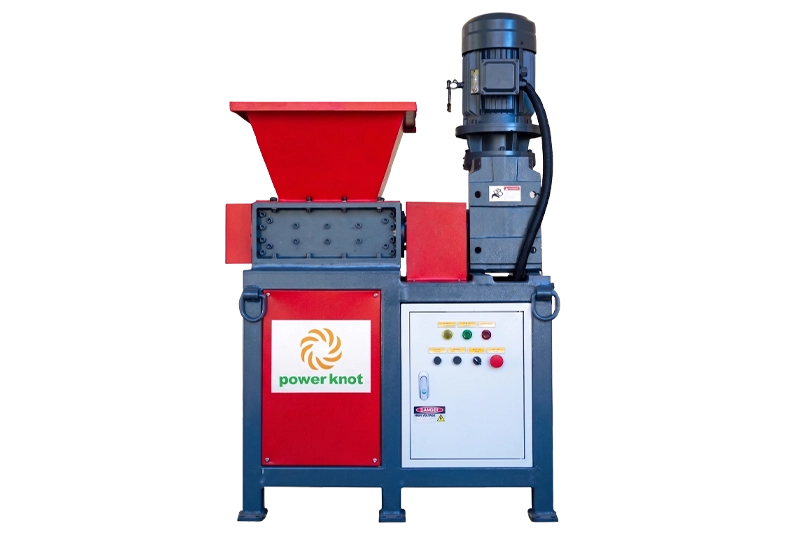
The Product
Power Knot LLC, a supplier of onsite organic waste management equipment, has relaunched its BCG shredder product line and released an updated BCG-150 model, aimed at commercial and industrial operators that need to reduce bulky or difficult organic materials before downstream processing. The company said both products are available immediately.
The BCG series uses powered cutting knives to reduce material volume and particle size, making it easier to move, handle, and feed waste into secondary systems. Targeted feedstocks include food waste, animal bones, meat processing byproducts, fruit and vegetable waste, and agricultural residues — categories that are notoriously difficult to manage at scale without pre-treatment.
Downstream Fit
The shredders are engineered to operate as standalone units or as an integrated component within a broader waste management chain. Reduced-size output is compatible with a range of recovery pathways, including biodigestion, composting, rendering, and recycling. Power Knot's own LFC biodigester, already deployed across foodservice, hospitality, and institutional settings, is a primary pairing for the BCG line.
Iain Milnes, President of Power Knot, said the BCG-150 update was driven directly by customer demand. "The BCG-150 shredder gives our customers greater flexibility to reduce difficult materials to a manageable size and prepare them for the next stage of processing," he said, adding that uptake is coming both from LFC biodigester users and from operators running other standalone processing applications.
Market Context
Demand for onsite organic waste processing equipment has grown alongside tightening landfill diversion mandates and rising hauling costs in commercial foodservice and food manufacturing. Operators in sectors ranging from protein processing to institutional dining are increasingly seeking solutions that consolidate pre-treatment and diversion in a single facility footprint, rather than relying on off-site rendering or composting contracts.
For food manufacturers and large foodservice operators, shredder-plus-biodigester configurations can reduce the labor and logistics burden associated with high-volume organic waste streams. The ability to handle animal bones and meat byproducts — materials that overwhelm standard biodigesters without pre-shredding — broadens the addressable market for both product lines.
The BCG relaunch extends Power Knot's equipment portfolio beyond biodigestion into what the company describes as auxiliary waste handling, a category that includes moving, lifting, grinding, pumping, and filtering functions across commercial and industrial waste streams. That positioning aligns with broader supply-chain trends in food manufacturing where vertical integration of waste handling is becoming a procurement priority.
For operators evaluating capital equipment decisions in this space, the BCG-150 fits a segment of the market previously covered by food waste reduction technology solutions that required separate pre-treatment steps — consolidating those into a single vendor relationship.
Written by Michael Politz, Author of Guide to Restaurant Success: The Proven Process for Starting Any Restaurant Business From Scratch to Success (ISBN: 978-1-119-66896-1), Founder of Food & Beverage Magazine, the leading online magazine and resource in the industry. Designer of the Bluetooth logo and recognized in Entrepreneur Magazine's "Top 40 Under 40" for founding American Wholesale Floral, Politz is also the Co-founder of the Proof Awards and the CPG Awards and a partner in numerous consumer brands across the food and beverage sector.