
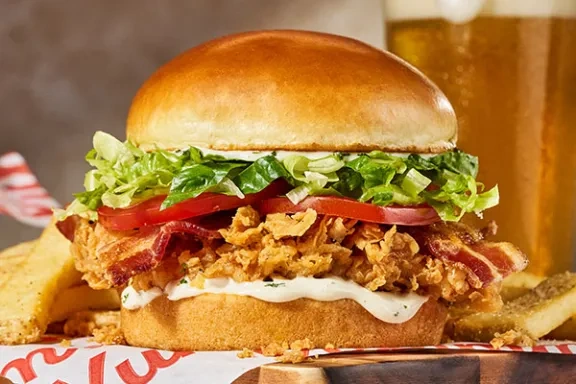
Red Robin Gourmet Burgers, Inc. (NASDAQ: RRGB) posted a 3.9% comparable-restaurant revenue gain in its fiscal third quarter ended October 4, 2026 — the strongest quarter-over-quarter swing in at least a year — as the casual dining chain completed the most consequential phase of a broad financial restructuring that transferred 108 company-owned units to franchisees for approximately $89.4 million in aggregate cash.
Total revenues for the twelve-week period fell to $232.1 million from $265.1 million a year earlier, a decline largely attributable to the shrinking company-operated footprint following the refranchising transactions. Restaurant-level operating profit came in at $24.0 million, or 10.8% of restaurant revenue, up 90 basis points from 9.9% in the third quarter of fiscal 2025. Adjusted EBITDA was $7.3 million versus $7.6 million in the prior-year period, with the marginal compression reflecting higher selling expenditures tied to the company's Big Yummm value platform and First Choice marketing strategy. The GAAP net loss widened to $21.2 million, or $(1.12) per diluted share, from a loss of $18.4 million, or $(1.03) per diluted share, in Q3 2025, partly burdened by a $4.2 million loss on the refranchise transactions and a $3.7 million loss on extinguishment of debt.
The Restructuring Math
The 3.9% comparable-sales gain was composed of a 5.6% increase in average guest check — aided by lapping the one-year anniversary of the Big Yummm value launch in July 2025 — partially offset by a 1.7% decline in guest traffic. The refranchising activity was executed through three separate transactions: 30 restaurants sold to Evergreen Dining LLC, 61 to Op Burgers, LLC, and 17 to Kuber Oregon, LLC and Kuber Washington, LLC. Subsequent to quarter-end, Op Burgers acquired six additional units for approximately $4.8 million, with two remaining locations expected to close before fiscal year-end pending liquor-license transfers.
The proceeds were applied to debt reduction and underpinned a refinancing completed October 2, 2026, replacing the existing credit facility with a new $115.0 million structure comprising a $90.0 million term loan and a $25.0 million revolving line of credit maturing October 2, 2031. As of the quarter's close, outstanding borrowings stood at approximately $100.0 million, down materially from long-term debt of $164.7 million recorded at the fiscal year-end of December 28, 2025. Total liquidity was approximately $29.5 million, including $23.8 million in cash. The shift toward a higher franchise mix is a well-worn capital-light playbook in casual dining — one that peers including Dine Brands and Bloomin' Brands have employed to lower capital intensity and stabilize cash flows, though it typically compresses near-term reported revenue even as royalty and franchise fee streams build.
Q4 Guidance and Transition Costs
For the fourth quarter of fiscal 2026, Red Robin guided comparable restaurant revenue growth of approximately 2.75%, restaurant-level operating profit margin of approximately 10.0%, and adjusted EBITDA of approximately $6.0 million. Management cautioned that Q4 figures include roughly $1.5 million of general liability expense related to the recently refranchised restaurants and do not yet capture the full run-rate overhead savings that a higher franchise mix is expected to generate. Dave Pace, President and Chief Executive Officer, said the dual progress on financial restructuring and comparable-sales recovery gives the company confidence that its First Choice Plan is working, while acknowledging that overhead optimization tied to the new franchise mix remains a work in progress.
For the forty-week period ended October 4, 2026, total revenues were $888.0 million versus $941.2 million in the year-ago period, with the year-to-date net loss totalling $23.0 million compared with a loss of $13.2 million through the same period of fiscal 2025. The year-to-date adjusted diluted loss per share narrowed to $(0.27) from $(0.23), a modest improvement on a per-share basis even as reported losses grew — reflecting higher transaction and transition charges that are excluded from the adjusted measure. Franchise revenue for the quarter rose to $5.7 million from $3.3 million a year earlier, an early signal of the royalty-stream build that management expects to accelerate. Operators and franchisees watching the casual dining segment will note that the brand's ability to convert comp momentum into unit-level profit recovery — while managing a simultaneous balance-sheet overhaul — will determine whether the First Choice Plan can close the gap to industry-level margin benchmarks.
Written by Michael Politz, Author of Guide to Restaurant Success: The Proven Process for Starting Any Restaurant Business From Scratch to Success (ISBN: 978-1-119-66896-1), Founder of Food & Beverage Magazine, the leading online magazine and resource in the industry. Designer of the Bluetooth logo and recognized in Entrepreneur Magazine's "Top 40 Under 40" for founding American Wholesale Floral, Politz is also the Co-founder of the Proof Awards and the CPG Awards and a partner in numerous consumer brands across the food and beverage sector.