
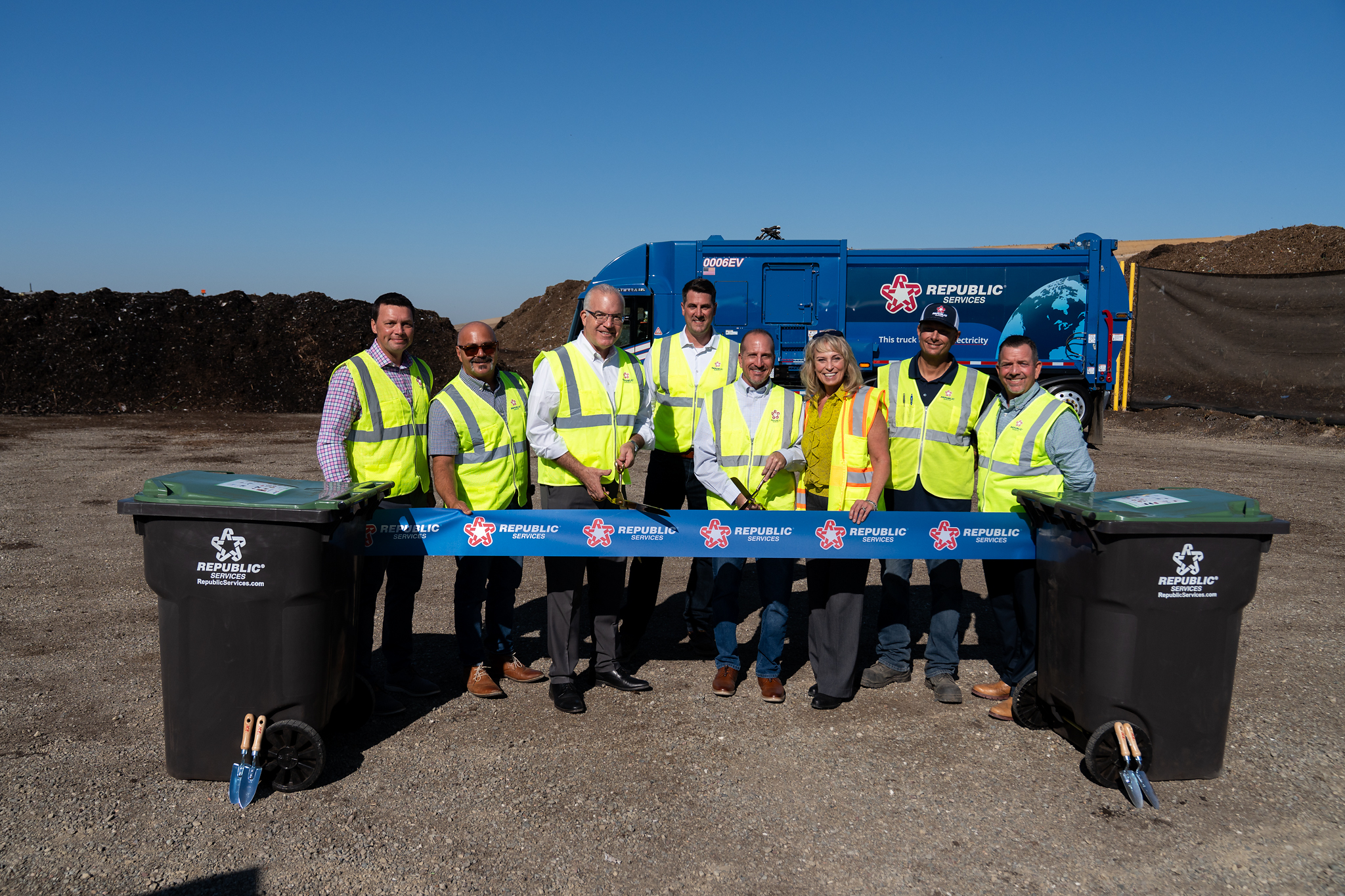
Republic Services has opened an expanded compost facility at Forward Landfill in San Joaquin County, California, capable of processing up to 147,000 tons of food scraps and yard waste annually — a move that directly tightens the supply loop between regional waste streams and California's agricultural sector.
The facility serves thousands of homes and businesses across Northern California, converting organic material into finished compost redistributed to local farmers, landscapers, and community projects. Construction was supported by a $5.1 million grant awarded in 2023 through CalRecycle's Organics Grant Program, which funds industry investments in clean technologies aimed at reducing greenhouse gas emissions.
The Numbers
The scale of California's organic waste problem underscores the commercial rationale. According to CalRecycle data cited in the announcement, 48% of material currently disposed of in California landfills is organic waste — equivalent to 2.5 billion meals' worth of unspoiled food per year. When organic material decomposes in landfills, it generates methane, a potent greenhouse gas. Republic Services processed 884,000 tons of food and yard waste across its California organics network in 2025, operating 17 facilities statewide, including green waste processing sites, compost operations, and commercial food waste handling.
"Each truckload of food and yard waste that arrives at Forward Landfill is transformed into nutrient-rich compost that supports local farmers, landscapers and even community projects," said Chris Seney, Director of Sustainability Innovation in Organics at Republic Services. "This facility represents composting on a whole different scale, with the technology and capacity to process thousands of tons of material per year."
Agricultural Supply Chain Link
For the food and beverage supply chain, the expansion has tangible downstream implications. Finished compost returning to Central Valley farmland supports soil health and drought resilience — factors increasingly material to commodity yields and input costs for California's fruit, vegetable, and nut growers. The circular model — collecting post-consumer food waste from commercial and residential accounts, processing it, and returning compost to agricultural land — mirrors the closed-loop systems that major food manufacturers and retailers have been pressing contract growers to adopt under their own sustainability commitments.
CalRecycle Director Zoe Heller framed the facility as a policy proof point: "A local circular economy in action, this site takes in food and green waste from homes and businesses and returns finished compost back to the community to support soil health, drought resilience and local food production."
What's Next
Republic Services signaled that the Forward Landfill expansion is one piece of a broader California buildout. Later in 2026, the company plans to open the San Bernardino Sustainability Park in San Bernardino County — described as one of the nation's largest organics facilities — with initial capacity to recycle 300,000 tons of food and green waste per year and room to double that figure. Forward Landfill is also developing a renewable natural gas facility on-site, adding an energy-recovery dimension to its organics processing footprint.
For food and beverage operators managing commercial food waste compliance under California's SB 1383 organics diversion law, the expanded infrastructure represents added processing capacity in a state where permitted organics facilities have historically been a bottleneck. Operators and foodservice distributors tracking California regulatory trends should note that the state's grant program signals continued public funding pressure on private operators to scale composting infrastructure. Industry observers following agricultural input markets and compost supply will watch whether the added volume meaningfully affects regional compost pricing.
Written by Michael Politz, Author of Guide to Restaurant Success: The Proven Process for Starting Any Restaurant Business From Scratch to Success (ISBN: 978-1-119-66896-1), Founder of Food & Beverage Magazine, the leading online magazine and resource in the industry. Designer of the Bluetooth logo and recognized in Entrepreneur Magazine's "Top 40 Under 40" for founding American Wholesale Floral, Politz is also the Co-founder of the Proof Awards and the CPG Awards and a partner in numerous consumer brands across the food and beverage sector.