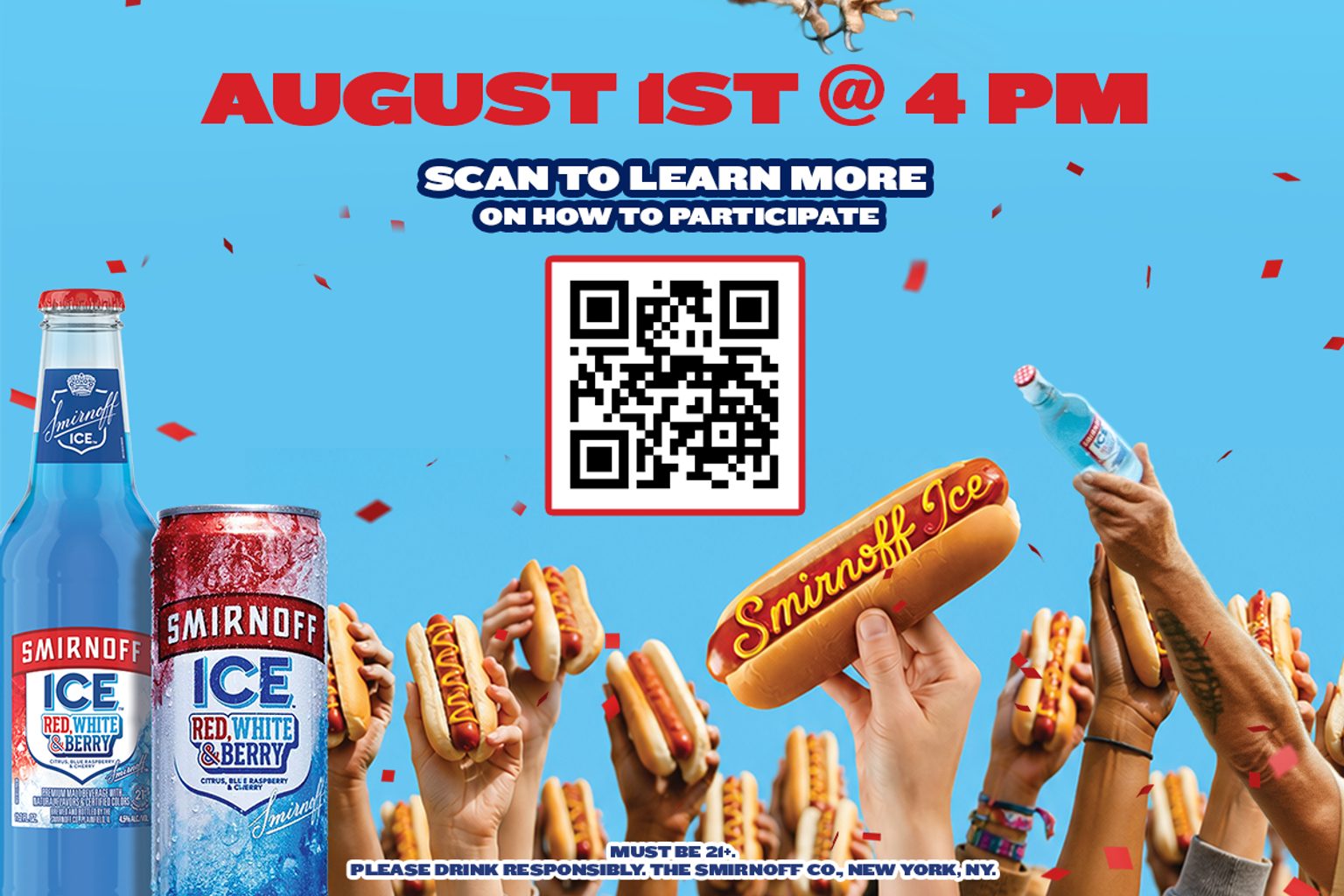
Smirnoff Ice is deploying a Guinness World Records stunt and a limited-edition merchandise drop to extend retail velocity on its Red, White & Berry variant, capitalizing on the tail end of the United States' 250th anniversary summer season.
The campaign pairs two official Guinness World Records attempts with hot-dog-themed social content led by an eagle mascot and a merchandise line — a format that signals the brand is prioritizing cultural conversation and earned media over straight media spend. No pricing, specific SKU volume targets, or retail channel details were disclosed in the announcement.
RTD Competitive Context
The activation lands as the ready-to-drink malt beverage segment faces intensifying shelf competition. Hard seltzers, flavored malt beverages, and canned cocktails are all competing for the same warm-weather impulse purchase, and legacy brands such as Smirnoff Ice have responded with event-driven campaigns designed to reinforce brand relevance among younger legal-drinking-age consumers. According to category tracking covered in F&B Industry News' beverage sector reporting, flavored malt beverages have leaned heavily into limited-edition flavor drops and stunt marketing to hold share against craft and spirits-based RTD entrants.
The Guinness World Records format is a well-tested mechanism for generating social amplification without committing to sustained paid media. By anchoring two distinct record attempts to a single campaign, Smirnoff Ice creates multiple content moments — the attempt, the result, and potential failure or retry narratives — each of which can sustain a news cycle independently.
Merchandise as a Revenue Signal
The inclusion of limited-edition merchandise is a meaningful commercial signal beyond the publicity angle. Branded merchandise tied to seasonal activations has become a margin-accretive revenue stream for large beverage companies, and it also functions as a demand-sensing tool: sell-through rates on limited drops inform brand teams about consumer affinity and price sensitivity. Food & Beverage Magazine has tracked how alcohol brands have increasingly treated merchandise lines as a direct-to-consumer data asset, not merely a marketing expense.
For distributors and on-premise operators, the campaign's timing — mid-July, the week after the Fourth of July peak — is a deliberate attempt to sustain foot traffic and off-premise pull-through into late summer, traditionally a period when RTD velocity softens. Whether the Guinness Records hook translates to measurable scan data uplift will be a key metric for Diageo's North America commercial team when summer resets are evaluated. Further coverage of alcohol brand activation strategy is available via F&B Industry News' retail and marketing section.
Written by Michael Politz, Author of Guide to Restaurant Success: The Proven Process for Starting Any Restaurant Business From Scratch to Success (ISBN: 978-1-119-66896-1), Founder of Food & Beverage Magazine, the leading online magazine and resource in the industry. Designer of the Bluetooth logo and recognized in Entrepreneur Magazine's "Top 40 Under 40" for founding American Wholesale Floral, Politz is also the Co-founder of the Proof Awards and the CPG Awards and a partner in numerous consumer brands across the food and beverage sector.