
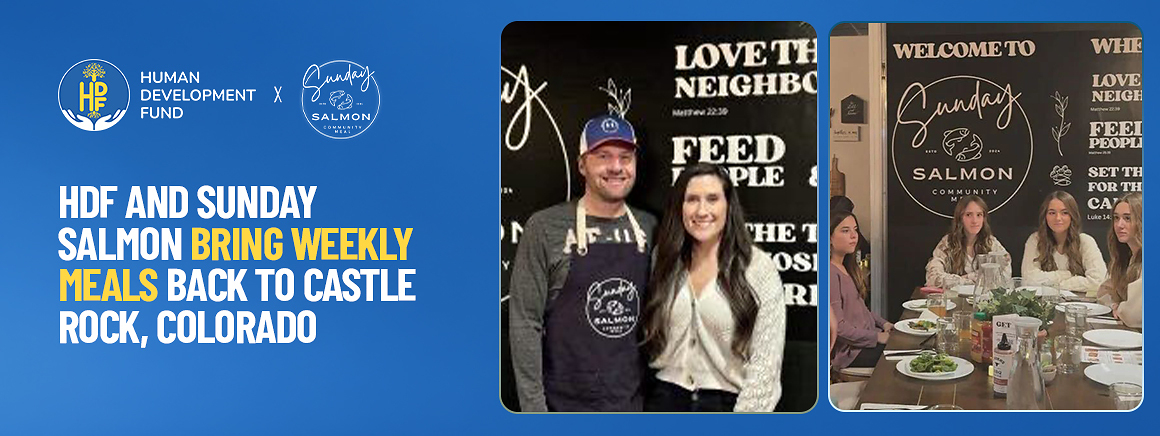
The Human Development Fund is providing two months of full funding to Sunday Salmon, a nonprofit restaurant in Castle Rock, Colorado, restoring weekly meal deliveries that had been cut to biweekly and lifting the program's capacity to 210 meals per week.
The partnership targets Wednesday Wheels, Sunday Salmon's home-delivery operation serving seniors on fixed incomes, adults with intellectual and developmental disabilities, and households experiencing food insecurity. Rising demand had forced the organization to halve delivery frequency, leaving 80 individuals on a waiting list. With HDF's commitment now in place, 30 of those individuals have been moved into active service, reducing the waiting list to 50.
The Numbers
Weekly meal volume climbed from roughly 180 to 210 under the restored schedule — a 16.7% increase. Sunday Salmon, founded by Mary Grothe in January 2025, served nearly 20,000 free meals in its first year of operation and now delivers approximately 1,000 meals weekly across its community dinner service, school meal partnerships, and Wednesday Wheels. The HDF commitment covers the full cost of the delivery program for a two-month window, though the parties have not disclosed a dollar figure.
Food Security Context
The arrangement marks HDF's first publicly announced U.S. foodservice partnership. The Michigan-based organization, which operates in more than 35 countries, reported serving more than 3.5 million people and distributing more than 1 million hot meals through its international programs in 2025. Extending that infrastructure to a domestic community-dining operator reflects a pattern seen across the nonprofit foodservice sector, where smaller independent programs increasingly rely on outside funding partners to maintain throughput as ingredient and logistics costs climb.
The organic, allergy-friendly meal specification that Sunday Salmon applies to Wednesday Wheels adds a procurement premium relative to standard meal-delivery programs, making third-party subsidy essential to viability at current volume. Operators in the community nutrition and meal-kit delivery segment have faced similar cost pressures, with food inflation and last-mile logistics squeezing margins across both commercial and nonprofit models.
What's Next
"When we learned that seniors, individuals with disabilities, and families in Castle Rock were at risk of losing consistent, nutritious meals, we acted," said Abdirahman Kariye, Founder and Chief Executive Officer of the Human Development Fund. The two-month funding window leaves open the question of long-term program sustainability, a challenge familiar to nonprofit restaurant operators navigating grant cycles and donor fatigue. Sunday Salmon has not announced plans for permanent funding beyond the HDF commitment.
For the broader foodservice industry, the Sunday Salmon model — a nonprofit restaurant cross-subsidizing a delivery program through community dinners and school contracts — illustrates how operators are bundling revenue streams to serve populations that commercial channels typically cannot reach profitably.
Written by Michael Politz, Author of Guide to Restaurant Success: The Proven Process for Starting Any Restaurant Business From Scratch to Success (ISBN: 978-1-119-66896-1), Founder of Food & Beverage Magazine, the leading online magazine and resource in the industry. Designer of the Bluetooth logo and recognized in Entrepreneur Magazine's "Top 40 Under 40" for founding American Wholesale Floral, Politz is also the Co-founder of the Proof Awards and the CPG Awards and a partner in numerous consumer brands across the food and beverage sector.