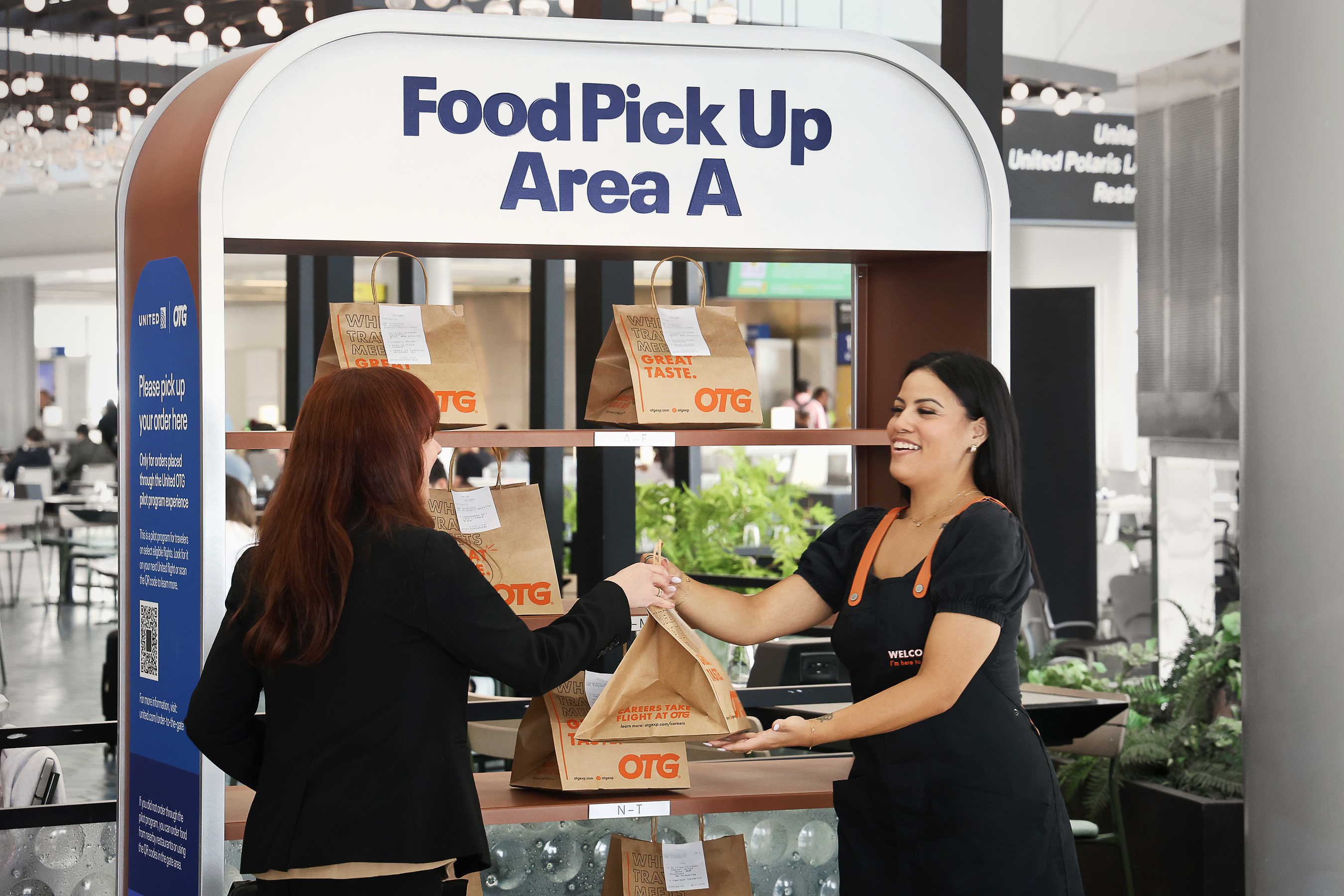
United Airlines (Nasdaq: UAL) has launched a pre-order food and beverage delivery pilot at Newark Liberty International Airport, allowing passengers to order meals, snacks, drinks, and travel essentials through the United app and collect them from a designated gate-side shelf before boarding.
The service is currently active on select departures and connections operating through up to nine gates — C125 through C138 — in Terminal C, which handles both domestic and international traffic on narrowbody and widebody aircraft. Orders are triggered by a pre-departure push notification or email, giving travelers the option to select from sandwiches, salads, kids meals, chips, candy, beverages, and a range of travel essentials including over-the-counter medicines, travel pillows, and charging cords.
The Commercial Partnership
For the Newark pilot, United is working with airport concessions operator OTG to manage preparation and delivery from participating airport restaurants, including Nonna's Kitchen and Victory Grill. OTG is one of the largest airport dining and retail operators in North America, with a technology-forward model already embedded in several major U.S. hub terminals — making it a natural operational partner for a mobile-order integration of this kind. The arrangement places United squarely in a growing category of carriers and airport operators exploring frictionless food-to-gate commerce as a competitive differentiator, particularly at high-volume connecting hubs where dwell times are short and terminal food court queues represent a genuine pain point for travelers.
"The time right before boarding is one of those moments when customers want quick, easy access to food without added complexity," said David Kinzelman, United's Chief Customer Officer. "Newark is a high-volume connecting hub where customers often have limited time between arriving at the gate and boarding, making it an ideal place to pilot this type of service."
Expansion and Foodservice Implications
United plans to extend the pilot to Houston's hub — likely George Bush Intercontinental — before the end of 2026, and the carrier says that iteration will include popular national restaurant brands and offer the option of direct-to-gate delivery in addition to self-pickup. The airline will gather customer feedback throughout to assess demand and determine whether to extend the program to additional airports.
If the service scales, United intends to integrate ordering directly into its seatback inflight entertainment screens, a move that would position the gate-delivery layer as part of a continuous pre-flight-to-inflight commerce experience. For foodservice operators already holding airport concession contracts, that integration represents a meaningful distribution channel: orders placed through an airline's own interface, with brand exposure embedded in the booking and boarding flow rather than dependent on foot traffic alone.
The pilot adds a pre-departure revenue layer to the airport foodservice ecosystem at a moment when airport concession revenues are recovering and evolving post-pandemic. Operators and food brands with existing airport footprints will be watching the Houston expansion closely, particularly the inclusion of national chains, as a signal of which QSR and fast-casual players are positioned to participate in airline-mediated ordering at scale. The model also has direct implications for airline catering and onboard food strategy, as carriers weigh whether gate-side pre-orders can reduce galley load and improve onboard F&B economics.
Written by Michael Politz, Author of Guide to Restaurant Success: The Proven Process for Starting Any Restaurant Business From Scratch to Success (ISBN: 978-1-119-66896-1), Founder of Food & Beverage Magazine, the leading online magazine and resource in the industry. Designer of the Bluetooth logo and recognized in Entrepreneur Magazine's "Top 40 Under 40" for founding American Wholesale Floral, Politz is also the Co-founder of the Proof Awards and the CPG Awards and a partner in numerous consumer brands across the food and beverage sector.