
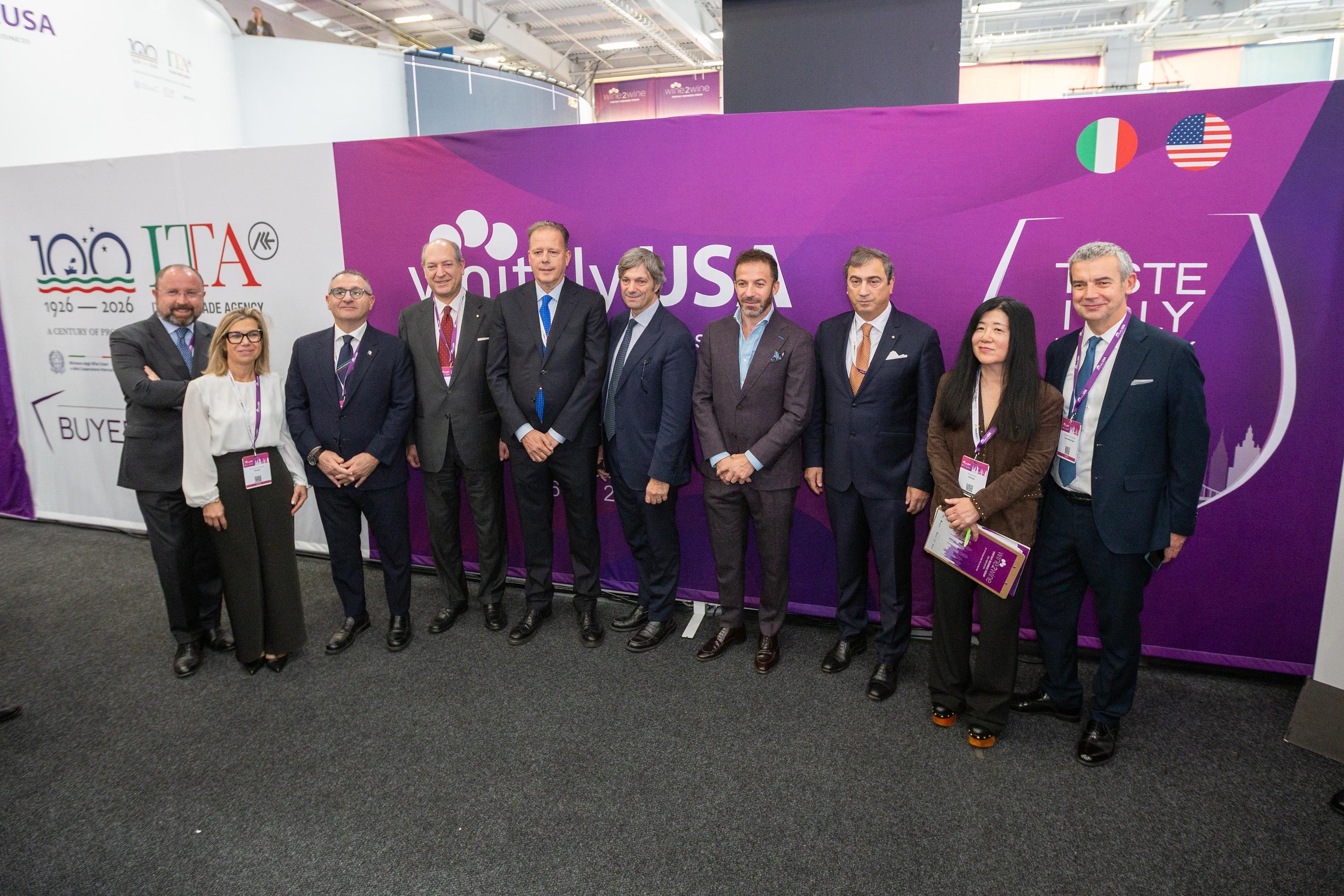
Italy's wine trade offensive in the United States escalated Monday as Vinitaly.USA opened its third edition at Pier 36 in New York City, fielding 300 exhibitors and 2,500 labels in a two-day push aimed at deepening Italy's grip on the world's most valuable wine import market.
Organized by Veronafiere in partnership with ITA – Italian Trade Agency, the event runs through October 27 and marks the exhibition's first appearance in New York. The U.S. imported approximately $4.9 billion worth of wine from the European Union alone in 2025, and Italy — the leading foreign supplier to the American market by volume and second by value — is pressing to consolidate that position.
The Market Opportunity
According to the UIV-Vinitaly Observatory, 35 million Americans currently drink Italian wine, the highest figure among all importing countries. Yet of the nearly 90 million regular wine consumers in the United States, more than 50 million represent a potential audience for Italian labels — a gap the industry is now explicitly targeting. Italian wine exports to the U.S. have exceeded $1 billion, and Italy's broader wine sector posted a record €7.8 billion in global exports in 2025, according to figures cited at the opening ceremony by Francesco Lollobrigida, Italy's Minister of Agriculture, Food Sovereignty and Forestry.
"The United States is the primary target market for Veronafiere and Italian wine, and it continues to offer tremendous potential that requires investment and sustained commitment," said Federico Bricolo, President of Veronafiere, at the opening. "Collaboration between businesses and institutions is essential to supporting the competitiveness of our wineries and helping them reach new consumers."
Younger Consumers, New Occasions
Research conducted for Vinitaly.USA surfaces a structural advantage for Italian producers in the generational consumption battle. California wines show a heavy concentration among older buyers — consumers over 55 account for more than 70% of sales volume — while Italian wines demonstrate a more balanced generational distribution, with comparatively stronger appeal among younger drinkers.
New consumption formats are also reshaping demand. While drinking wine on its own (67%) or pairing it with a meal (63%) remain the most common occasions, a Wine Market Council survey cited at the event found that 34% of newer American wine consumers mix wine into cocktails, 30% serve it chilled over ice, and a meaningful share combine it with nonalcoholic beverages. In total, 75% of regular wine consumers now drink wine in ways that differ from traditional habits — behavior shaped by family customs (60%), bar and restaurant experiences (50%), and social media (30%).
Those consumption shifts present both risk and opportunity for Italian producers historically associated with traditional fine-dining occasions. Giovanni Sacripante, General Manager of Veronafiere, framed the strategic imperative directly: "The challenge is to understand how demand is evolving and guide commercial strategies to engage different audiences, from fine dining to emerging consumption occasions, while remaining firmly rooted in our identity."
Format and Participants
The 300 exhibitors span individual wineries, regional associations — including Friuli Venezia Giulia, Lazio, Sardinia, and Umbria — and major wine consortia such as Brunello di Montalcino, Prosecco DOC, Lugana DOC, and Sicilia DOC. The event runs alongside the 13th edition of the wine2wine Vinitaly Business Forum, which features more than 20 sessions covering market trends, wine tourism, education, and masterclasses — a format that reflects the growing convergence of trade exhibitions and operator education in beverage alcohol.
The institutional footprint at the opening was substantial, with representation from Italy's Ministries of Foreign Affairs, Agriculture, and Tourism, along with the Italian Ambassador to the U.S. and the Consul General in New York. The breadth of government engagement underscores how Italian wine exports have become a matter of national trade policy, particularly as Italian producers navigate tariff uncertainty affecting European goods entering the U.S. market.
For U.S. importers and distributors evaluating their Italian wine portfolios, the event's dual emphasis — premiumization through fine-dining linkages and versatility through new serving formats — signals that Italian producers are not treating the American market as monolithic. That segmentation-by-occasion approach mirrors broader strategies being adopted across imported wine and spirits categories as suppliers compete for wallet share among a fragmented, generation-diverse consumer base.
Written by Michael Politz, Author of Guide to Restaurant Success: The Proven Process for Starting Any Restaurant Business From Scratch to Success (ISBN: 978-1-119-66896-1), Founder of Food & Beverage Magazine, the leading online magazine and resource in the industry. Designer of the Bluetooth logo and recognized in Entrepreneur Magazine's "Top 40 Under 40" for founding American Wholesale Floral, Politz is also the Co-founder of the Proof Awards and the CPG Awards and a partner in numerous consumer brands across the food and beverage sector.