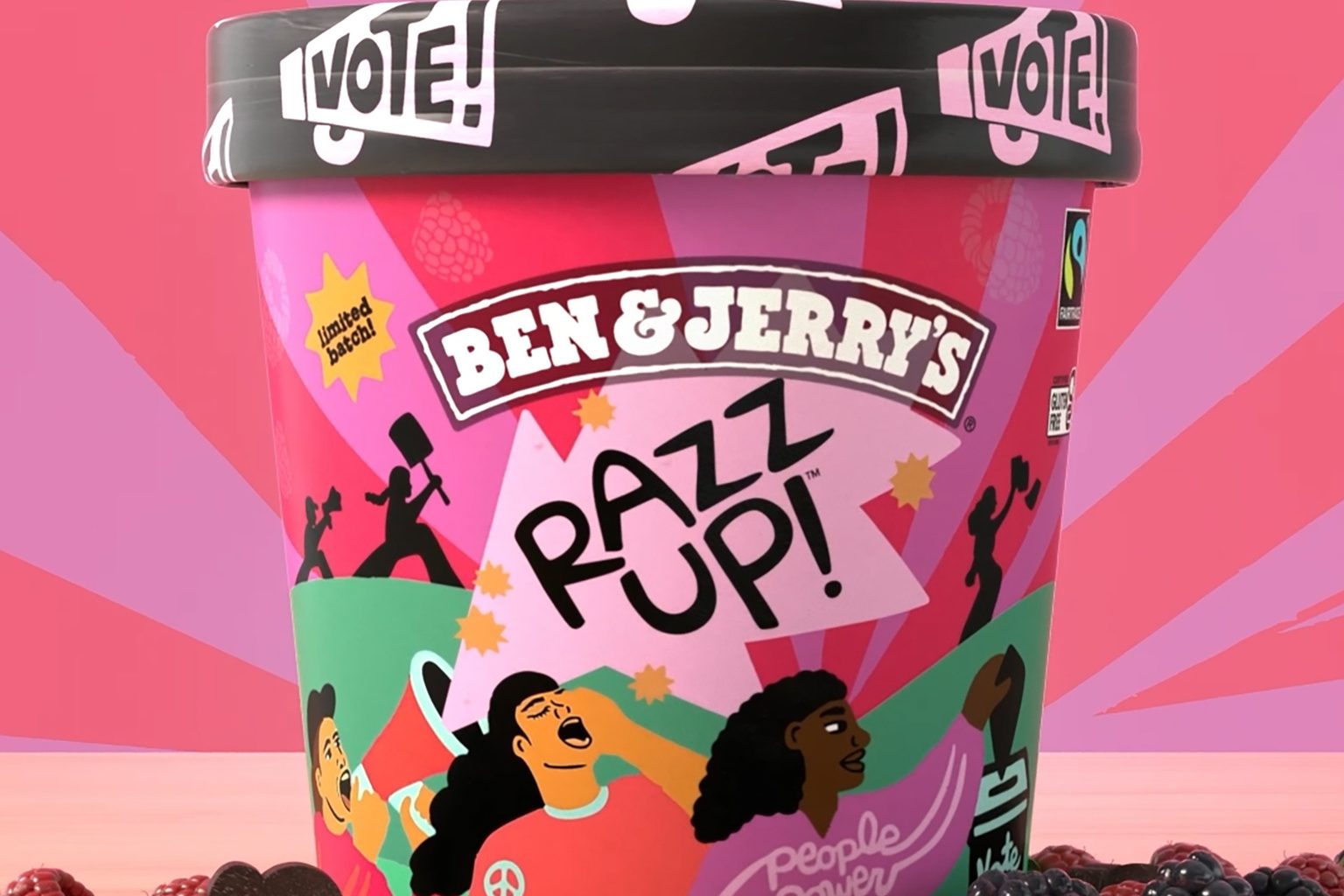
Ben & Jerry's is introducing Razz Up!, a new ice cream flavor anchored to a voter-mobilization campaign ahead of the November 2026 U.S. midterm elections, the Vermont-based brand announced Wednesday. The launch marks one of the more overtly political product introductions in the premium ice cream segment in recent memory, targeting what the company describes as threats to voting access and civil liberties.
The Product & Campaign
The Razz Up! campaign is designed to drive civic engagement among Ben & Jerry's core consumer base, with the brand calling on communities to participate in the 2026 midterms. The company has positioned the flavor as a vehicle for political messaging rather than a standalone commercial release — a strategy it has deployed repeatedly over the past decade, from the "Pecan Resist" flavor in 2018 to "Save Our Swirled" tied to climate advocacy.
Ben & Jerry's did not disclose a suggested retail price, distribution footprint, or projected unit volumes for Razz Up! in its announcement. The flavor is expected to be available through the brand's standard retail channels, which span grocery, convenience, and direct-to-consumer scoop shops across the United States.
Brand Strategy Under Scrutiny
The launch arrives at a complicated moment for Ben & Jerry's corporate identity. The brand has been engaged in a high-profile legal dispute with parent company Unilever over the scope of its independent social mission board's authority — a conflict that drew significant attention across the food and beverage industry and raised questions about how far a subsidiary can diverge from its parent's political posture.
For Unilever, which acquired Ben & Jerry's in 2000, the brand's activism has historically been both a point of differentiation and a reputational risk factor. Cause-marketing in the premium frozen desserts category has become increasingly common, but few brands pursue it with Ben & Jerry's consistency or intensity. The strategy has demonstrably supported brand loyalty among younger, values-driven consumers — a cohort that represents disproportionate purchasing power in the specialty grocery channel.
The 2026 midterm election cycle is shaping up as fertile ground for civic-engagement campaigns across consumer goods broadly, with multiple brands testing purpose-driven activations as a mechanism for deepening consumer relationships. Ben & Jerry's, however, remains the clearest example of a food brand that treats political advocacy as a core product attribute rather than a periodic marketing tactic. Whether Razz Up! moves meaningful volume will depend less on the flavor profile and more on how galvanizing the electoral environment proves to be for the brand's audience over the next several months.
As Food & Beverage Magazine has documented, purpose-led CPG brands have faced mounting pressure to demonstrate that social campaigns translate to tangible commercial returns — a calculus Ben & Jerry's has long resisted framing in purely financial terms.
Written by Michael Politz, Author of Guide to Restaurant Success: The Proven Process for Starting Any Restaurant Business From Scratch to Success (ISBN: 978-1-119-66896-1), Founder of Food & Beverage Magazine, the leading online magazine and resource in the industry. Designer of the Bluetooth logo and recognized in Entrepreneur Magazine's "Top 40 Under 40" for founding American Wholesale Floral, Politz is also the Co-founder of the Proof Awards and the CPG Awards and a partner in numerous consumer brands across the food and beverage sector.