The Launch
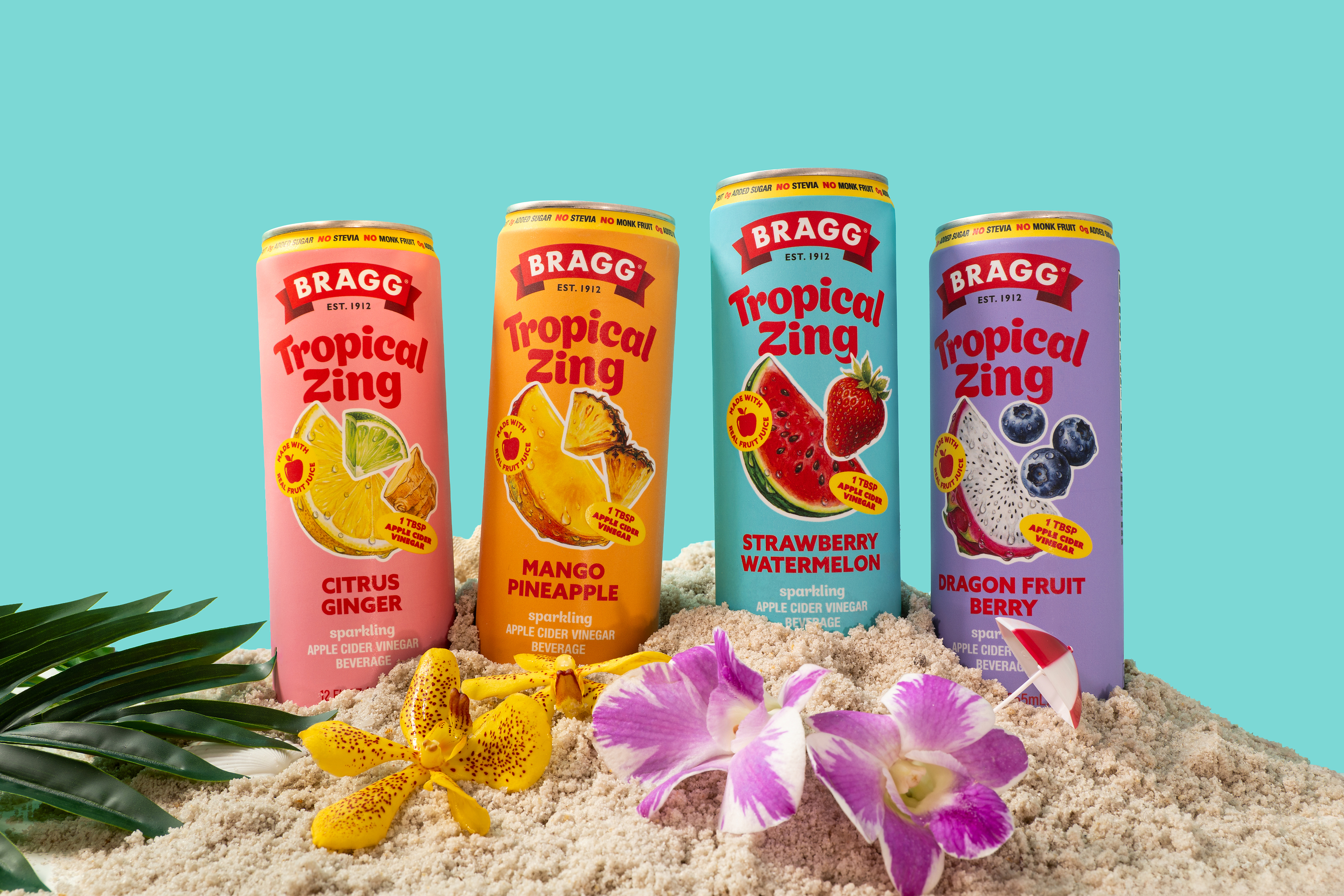
Bragg Live Foods, the 114-year-old natural food company behind America's best-selling apple cider vinegar, is pushing into the functional ready-to-drink sparkling category with Tropical Zing, a four-SKU line that embeds one full tablespoon of Bragg Organic Apple Cider Vinegar into each 12-ounce can. Suggested retail pricing is set at $2.49 per single can and $8.99 per four-pack, with e-commerce availability beginning late October 2026.
The lineup spans Strawberry Watermelon, Mango Pineapple, Citrus Ginger, and Dragon Fruit Berry. Each can contains 40 calories, 0 grams of added sugar, real fruit juice, and carries Non-GMO Project Verification. The formulation uses no stevia or monk fruit sweeteners — a deliberate positioning choice in a segment where alternative sweeteners have drawn consumer scrutiny.
The Market Rationale
Bragg's move reflects a calculated response to a documented friction point in the wellness category. A Bragg-commissioned Attitudes & Usage survey of 2,010 U.S. adults conducted by Big Village Research in early 2025 found that nearly 35% of Americans say taste prevents them from making apple cider vinegar a regular part of their wellness routine. A separate Bragg survey of 1,000 U.S. adults conducted by Talker Research in August 2026 found that 57% of Americans want a simpler approach to supporting their health and 47% report feeling overwhelmed by managing their overall well-being.
That data makes the RTD format a logical bridge: it removes the palatability barrier without requiring consumers to change behavior around supplement or shot formats. The functional beverage aisle — which spans everything from probiotic sodas to adaptogenic sparkling waters — has been one of the fastest-growing segments in non-alcoholic beverages, drawing legacy brands seeking incremental volume beyond their core SKUs.
Competitive Position
"We believe that wellness works best when it's simple, enjoyable, and fits into your everyday routine," said Linda Boardman, Chief Executive Officer of Bragg Live Food Products. Boardman framed the launch as a natural evolution rather than a category pivot, citing Bragg's role in introducing apple cider vinegar as a daily ritual to multiple consumer generations.
Bragg enters a sparkling ACV space that has attracted smaller challenger brands over the past several years, but the company's heritage — founded in 1912, with ACV as its anchor product — gives it a brand-authority advantage that most functional beverage entrants lack. The company distributes across natural food retailers, grocery chains, mass retailers, and online marketplaces, and the Tropical Zing rollout begins exclusively through e-commerce before any announced brick-and-mortar expansion. For food and beverage operators and grocery buyers evaluating functional wellness sets, the initial DTC-first approach provides a lower-risk trial window before committing shelf space.
The launch also aligns with broader Food & Beverage Magazine reporting on wellness brands converting ingredient equity into finished-beverage revenue, a strategy that reduces dependence on a single SKU while extending brand relevance across dayparts.
Written by Michael Politz, Author of Guide to Restaurant Success: The Proven Process for Starting Any Restaurant Business From Scratch to Success (ISBN: 978-1-119-66896-1), Founder of Food & Beverage Magazine, the leading online magazine and resource in the industry. Designer of the Bluetooth logo and recognized in Entrepreneur Magazine's "Top 40 Under 40" for founding American Wholesale Floral, Politz is also the Co-founder of the Proof Awards and the CPG Awards and a partner in numerous consumer brands across the food and beverage sector.