The Numbers
Deere & Company (NYSE: DE) reported third-quarter net income of $1.379 billion, or $5.10 per diluted share, for the period ended August 2, 2026 — a 7.0% increase from $1.289 billion, or $4.75 per diluted share, in the year-earlier quarter. Worldwide net sales and revenues rose 5.0% to $12.608 billion, with equipment net sales alone advancing to $10.999 billion from $10.357 billion a year ago.
For the nine months ended August 2, 2026, net income attributable to Deere was $3.808 billion, or $14.06 per diluted share, compared with $3.962 billion, or $14.57 per diluted share, in the same period last year — a 4.0% decline that reflects the broader downturn in large agricultural equipment demand that has pressured the sector since late fiscal 2024. Total operating profit for the quarter climbed 18.0% to $1.856 billion from $1.568 billion a year prior, driven largely by gains in Construction & Forestry and Small Agriculture & Turf.
Segment Divergence
The quarter's results exposed a widening performance gap across Deere's three equipment segments. Construction & Forestry posted a standout quarter, with net sales up 18.0% to $3.618 billion and operating profit surging 84.0% to $436 million, lifting the segment's operating margin to 12.1% from 7.7% a year earlier. The improvement reflects strong price realization on construction and roadbuilding equipment, categories that remain in demand across the North American infrastructure and housing sectors.
Small Agriculture & Turf also outperformed, with net sales rising 12.0% to $3.383 billion and operating profit jumping 28.0% to $622 million. The segment's margin expanded to 18.4% from 16.0%, benefiting from higher shipment volumes and favorable pricing — a signal that compact and turf equipment demand remains comparatively resilient even as large-format ag machinery faces headwinds. For the foodservice and agri-food supply chain, this matters: contractors and food-production growers operating smaller, diversified acreage are continuing to invest in equipment.
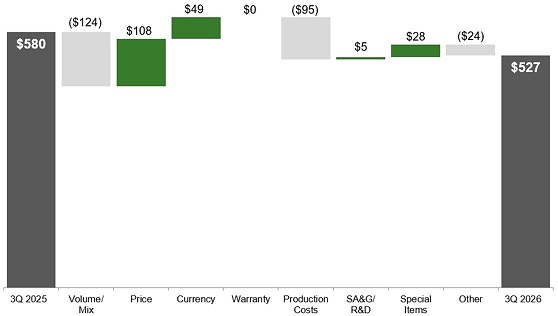
Production & Precision Agriculture — Deere's largest segment by revenue and the bellwether for global crop-input economics — reported a 6.0% decline in net sales to $3.998 billion, with operating profit falling 9.0% to $527 million and margins narrowing to 13.2% from 13.6%. Lower shipment volumes and an unfavorable product mix weighed on results, partially offset by price realization and $110 million in tariff recoveries booked in the quarter (cumulative tariff recoveries for the nine-month period totalled $382 million).
Financial Services contributed $219 million of net income, up 7.0% from $205 million, on favorable financing spreads, though a shrinking average portfolio capped the gain.
Cycle Positioning and Outlook
Chief Executive John C. May characterised the quarter as evidence of operational discipline in a cyclically difficult environment. "Early order program trends, improving used-equipment inventories, and increasing customer adoption of our advanced technologies give us confidence that Deere is well positioned for long-term value creation," he said in prepared remarks, adding that the company continues to believe fiscal 2026 will mark the bottom of the current agricultural equipment cycle.
Management raised full-year net income guidance to a range of $4.75 billion to $5.00 billion. Industry volume forecasts for fiscal 2026 reflect the bifurcated landscape: U.S. and Canadian large-ag equipment demand is expected to fall 15% to 20%, while South American tractors and combines face a similar decline. European volumes are seen as flat. Small Ag & Turf in the U.S. and Canada is projected to be flat to up 5%, and U.S. and Canadian construction equipment is forecast up 5% to 10%.
For food and beverage operators, ingredient buyers, and agricultural suppliers tracking input economics, the order-book improvement in precision ag technology adoption is a forward indicator worth watching. As Deere's precision agriculture platforms expand — supplemented by the February 2026 acquisition of Tenna LLC, a construction technology and asset-tracking company, for $439 million — data-driven farm management tools are expected to support yield optimization even as equipment unit volumes remain compressed. Readers tracking the broader crop-input and food-supply landscape can follow related coverage at /category/agribusiness-supply-chain and /category/industry-earnings.
Written by Michael Politz, Author of Guide to Restaurant Success: The Proven Process for Starting Any Restaurant Business From Scratch to Success (ISBN: 978-1-119-66896-1), Founder of Food & Beverage Magazine, the leading online magazine and resource in the industry. Designer of the Bluetooth logo and recognized in Entrepreneur Magazine's "Top 40 Under 40" for founding American Wholesale Floral, Politz is also the Co-founder of the Proof Awards and the CPG Awards and a partner in numerous consumer brands across the food and beverage sector.