
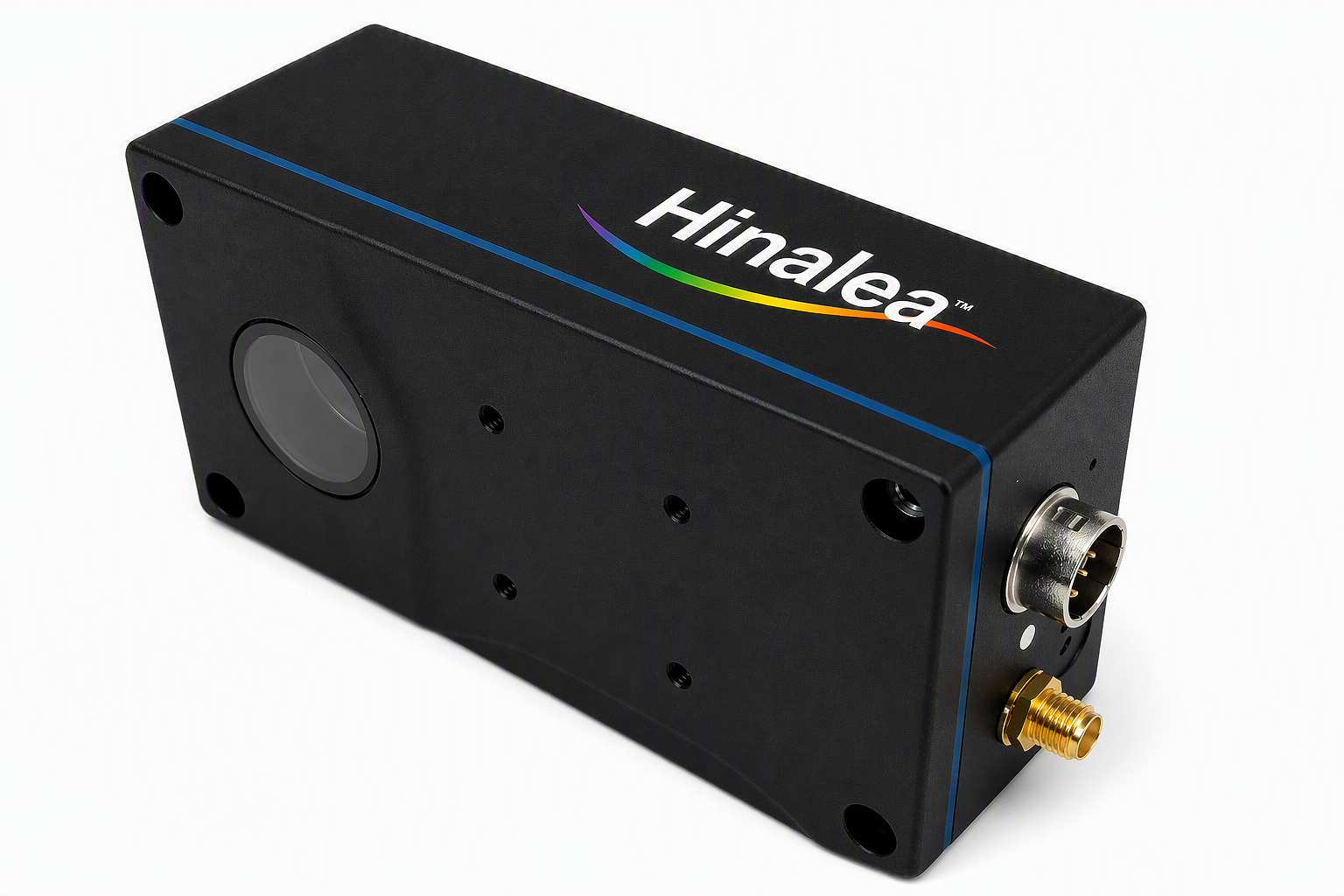
A new compact hyperspectral camera from Hinalea Imaging Corp. cuts hardware costs by approximately 70% compared with conventional visible and near-infrared systems, a price reduction the company says removes the primary economic barrier keeping the technology out of food and beverage production environments.
The VNIR CORE, launched September 30, covers the 420–980 nm spectral range and delivers 40 spectral bands at 14 nm FWHM resolution across a 1,280 × 1,024-pixel sensor. At 112 × 56 × 34 mm and 235 grams, the unit draws 4.5 watts over USB 3.0 — specifications designed to support integration into inline conveyor systems, OEM inspection rigs, and drone-based agricultural platforms where size, weight, and power budgets are constrained.
Why It Matters for F&B
Hyperspectral imaging has long been used in food quality and safety research because it can detect chemical composition, moisture content, microbial presence, foreign-body contamination, and surface defects that standard RGB machine-vision cameras miss. The obstacle has been cost: full VNIR systems have historically run to tens of thousands of dollars per unit, limiting deployment to high-value lines or government-funded inspection programmes. A 70% reduction in hardware cost, if realised at volume, would put per-unit economics in range for mid-scale processors and contract manufacturers who have so far relied on conventional optical sorting and manual QC.
Hinalea pairs the VNIR CORE sensor with its AI platform, which applies deep machine-learning models to translate raw spectral data into real-time actionable alerts — flagging contamination, toxin indicators, or quality deviations without requiring an on-site spectroscopist. That software layer is central to the company's inspection-as-a-service commercial model, in which Hinalea deploys hardware and captures recurring revenue from data and analytics rather than one-time equipment sales.
Competitive Landscape
"For years, hyperspectral imaging has largely remained the domain of laboratory research, with the cost and complexity of sensors limiting commercial adoption," said Barry McDonogh, Chief Executive Officer of Hinalea Imaging. "By dramatically reducing hardware cost while retaining the spectral intelligence that makes HSI so powerful, we can bring laboratory-grade chemometrics to industrial inspection and enable hyperspectral imaging to be deployed at scale."
The food-inspection technology market is attracting growing capital as processors face tightening regulatory scrutiny on allergen labelling, mycotoxin limits, and foreign-body tolerances. Hyperspectral sensing competes with X-ray inspection, near-infrared bulk analysers, and emerging laser-diffraction systems, each with different cost and throughput profiles. The VNIR CORE's MEMS-based architecture — a fabrication approach that borrows miniaturisation techniques from semiconductor manufacturing — is Hinalea's stated basis for the cost reduction, though independent validation of production pricing has not been published.
The system is being demonstrated at the VISION 2026 machine-vision trade fair in Stuttgart, Germany, from October 6 through October 8. Food and beverage manufacturers evaluating automated quality-control technologies or operators assessing supply-chain inspection upgrades may find the platform relevant as inline HSI moves closer to commodity pricing.
Written by Michael Politz, Author of Guide to Restaurant Success: The Proven Process for Starting Any Restaurant Business From Scratch to Success (ISBN: 978-1-119-66896-1), Founder of Food & Beverage Magazine, the leading online magazine and resource in the industry. Designer of the Bluetooth logo and recognized in Entrepreneur Magazine's "Top 40 Under 40" for founding American Wholesale Floral, Politz is also the Co-founder of the Proof Awards and the CPG Awards and a partner in numerous consumer brands across the food and beverage sector.