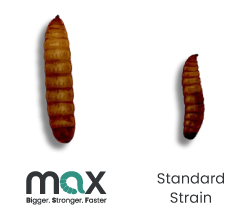
NRGene Canada and Ile-a-la-Crosse Fish Company Inc. have validated a dedicated feed recipe built on regional fish-processing by-products, producing black soldier fly (BSF) larvae enriched with the marine omega-3 fatty acids EPA and DHA at semi-industrial scale — a result the partners say opens a new category of high-value insect-derived poultry feed supplements.
The Trial Numbers
The semi-industrial run, conducted at the North American Insect Center (NAIC) in Saskatoon, processed 0.3 metric tons of feed containing 50% fish-processing by-products and yielded approximately 90 kilograms of MaxBSF™ larvae at a wet feed-conversion ratio of roughly 3.3. The complete rearing cycle ran eleven days — a five-day nursery stage followed by six days of grow-out. Independent analysis by Prairie Tide Diversified Inc., a CALA-accredited laboratory in Saskatoon, found that the fish-fed larvae carried total omega-3 content of 5.16% to 7.94% as a share of total fatty acids, compared with 1.12% in larvae of the same genetics raised on standard feed. EPA concentrations ranged from 1.14% to 1.89% and DHA from 0.37% to 0.65%; neither fatty acid was detected in the control group. The omega-6 to omega-3 ratio in the fish-fed larvae fell to as low as 1.2:1, against 12.8:1 in standard-feed larvae.
"These results matter because conventional BSF larvae generally contain very limited levels of EPA and DHA," said Dr. Ben Gradus, Director of Product, BSF at NRGene Canada. "By incorporating fish-processing by-products into the feed, we can produce MaxBSF™ larvae that combine insect protein with valuable marine omega-3 fatty acids."
Why It Matters for Feed Markets
The nutritional upgrade is commercially significant in the context of alternative protein sourcing trends in the poultry and egg sectors. Enriching broiler and layer diets with EPA and DHA is well-established as a strategy for producing omega-3-fortified eggs and meat, but marine-derived inputs — primarily fishmeal and fish oil — carry supply-chain risk and price volatility. A domestically produced BSF ingredient that inherits marine fatty-acid profiles from circular waste streams could reduce that dependence, particularly for Canadian producers seeking to differentiate on nutritional claims.
The partnership, originally announced in January 2025, was designed to address a specific supply-chain inefficiency: fish-processing by-products in northwest Saskatchewan spoil rapidly and have limited existing economic uses. Yossi Levi, Chief Business Officer of NRGene Canada, said the semi-industrial run confirmed both process scalability and commercial economics. Fish-by-product-based feedstocks are challenging in conventional BSF production because of their high moisture and fat content, which accelerates spoilage; the validated feed recipe and controlled rearing conditions are intended to make consistent use commercially viable.
Hub-and-Spoke Expansion
With the feed recipe validated, the two parties are planning an on-site BSF rearing facility in Ile-a-la-Crosse, Saskatchewan, scaled to the volume of by-products the region generates. Rearing close to the feedstock source eliminates the need to transport a highly perishable input. Larvae neonates would be supplied by FairGene, a joint venture between NRGene Canada and Fairville Farming Co. in Bassano, Alberta, which began BSF egg production in July 2026. The arrangement illustrates NRGene Canada's hub-and-spoke model — centralized egg and neonate production paired with regional grow-out sites anchored to local organic by-product streams — that Levi characterized as replicable across other regional waste sources.
"This is a scalable model, not a one-time project," Levi said. "Many regional by-product streams could benefit from the same approach."
The enhanced larvae also underpin NRGene Canada's dried ingredient brand MaxBites™, potentially positioning it as a premium poultry feed supplement carrying certified omega-3 credentials — a differentiation lever as ingredient buyers increasingly demand traceability and nutritional substantiation from alternative protein suppliers.
Written by Michael Politz, Author of Guide to Restaurant Success: The Proven Process for Starting Any Restaurant Business From Scratch to Success (ISBN: 978-1-119-66896-1), Founder of Food & Beverage Magazine, the leading online magazine and resource in the industry. Designer of the Bluetooth logo and recognized in Entrepreneur Magazine's "Top 40 Under 40" for founding American Wholesale Floral, Politz is also the Co-founder of the Proof Awards and the CPG Awards and a partner in numerous consumer brands across the food and beverage sector.