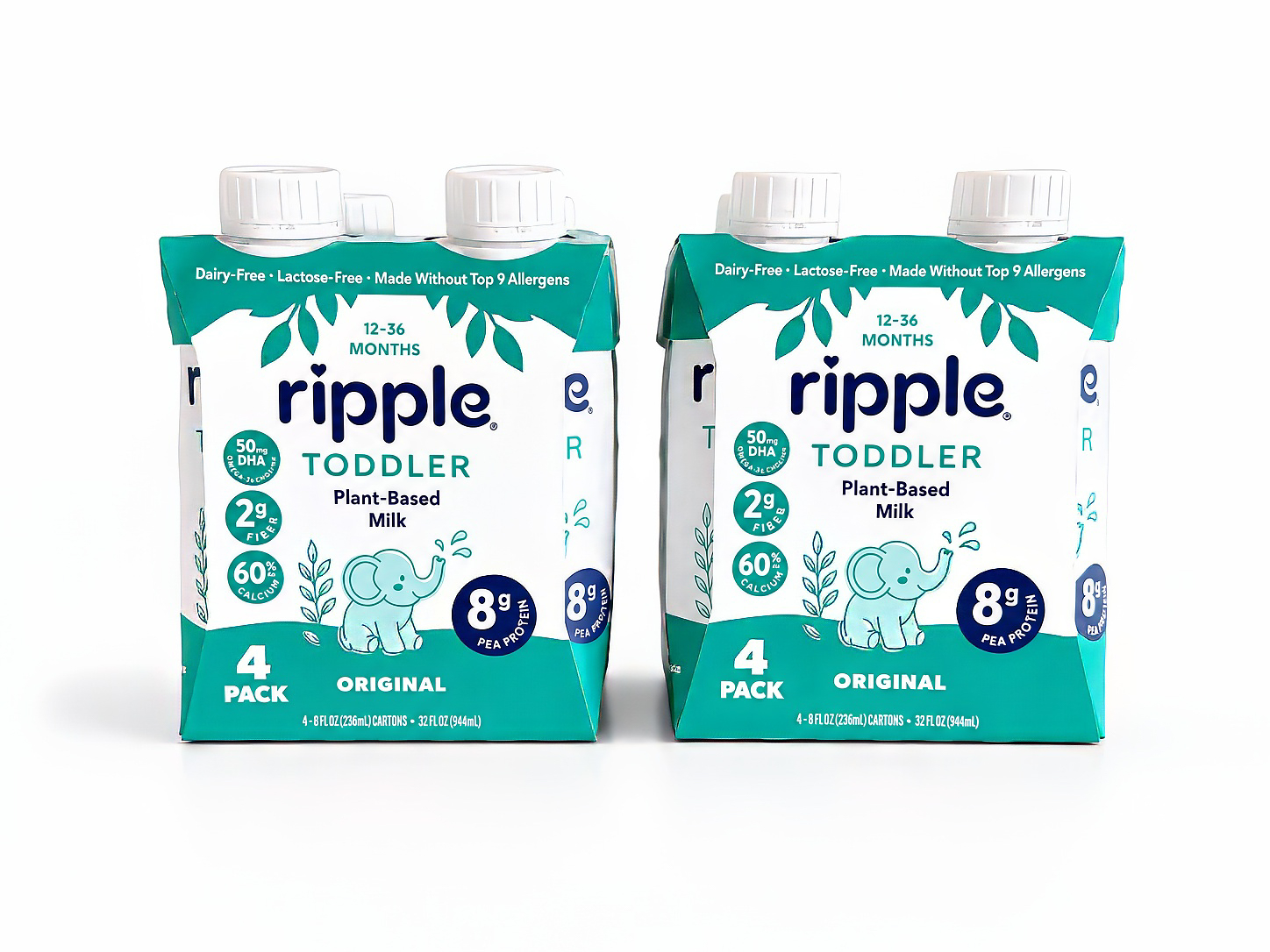
Berkeley-based Ripple Foods is expanding its plant-based dairy portfolio into the toddler segment, launching Ripple Toddler Plant-Based Milk exclusively through Walmart stores nationwide and on Walmart.com. The product, priced at an MSRP of $8.96 for a 4-pack of 8-ounce cartons, lands in Walmart's Baby Aisle — positioning it directly alongside conventional toddler formulas and transition milks rather than the refrigerated dairy-alternative set.
The Product Case
Each 8-ounce shelf-stable carton delivers 8 grams of pea protein, DHA omega-3s, choline and prebiotic fiber, along with calcium equivalent to 60% of a toddler's recommended daily intake. The product is free of all top-nine allergens and carries dairy-free, soy-free, nut-free, gluten-free and vegan certifications — a combination that broadens the addressable household pool significantly in the allergy-aware parenting segment. Available in Original and Unsweetened Original varieties, the shelf-stable format requires no refrigeration until opened, reducing friction for daycare and travel use cases.
The Walmart exclusivity agreement is a meaningful strategic lever. The retailer commands the largest share of U.S. grocery spend and runs one of the country's highest-traffic baby-product aisles, giving Ripple immediate national scale without a phased regional rollout. Placement in the Baby Aisle rather than the plant-based or refrigerated-beverage section also exposes the brand to shoppers who may not regularly browse alternative-dairy fixtures — a distribution tactic with precedent in the non-alcoholic beverage category.
Market Positioning
The toddler nutrition segment has historically been dominated by dairy-based transition formulas and conventional whole milk, but consumer interest in allergen-friendly and plant-based alternatives for young children has accelerated alongside broader plant-based food and beverage category growth. Ripple Foods, a Certified B Corporation, already markets Ripple Kids — a pea-milk line aimed at older children — giving it brand equity and retailer relationships to leverage as it moves down the age curve.
CEO Becky O'Grady framed the launch as a natural extension of that existing franchise. "We've seen how strongly Ripple Kids resonates with families looking for protein-forward, allergen-friendly nutrition," she said. "Ripple Toddler allows us to support families even earlier, with nutrition designed for this important stage and a shelf-stable format that can go wherever their day takes them."
What's Next
Ripple does not disclose revenue figures publicly, and the company provided no sales targets or distribution-expansion timeline alongside the launch announcement. However, an exclusive Walmart window is a standard proving-ground structure in consumer packaged goods: if velocity data supports expansion, broader multi-channel distribution — including specialty and natural grocery — typically follows within 12 to 18 months. Operators in the foodservice and childcare-facility channels, where shelf-stable single-serve formats carry logistical advantages, could represent a secondary addressable market if the retail launch performs. Industry observers will watch whether the Baby Aisle placement drives incremental trial from shoppers outside Ripple's established plant-based consumer base.
Written by Michael Politz, Author of Guide to Restaurant Success: The Proven Process for Starting Any Restaurant Business From Scratch to Success (ISBN: 978-1-119-66896-1), Founder of Food & Beverage Magazine, the leading online magazine and resource in the industry. Designer of the Bluetooth logo and recognized in Entrepreneur Magazine's "Top 40 Under 40" for founding American Wholesale Floral, Politz is also the Co-founder of the Proof Awards and the CPG Awards and a partner in numerous consumer brands across the food and beverage sector.