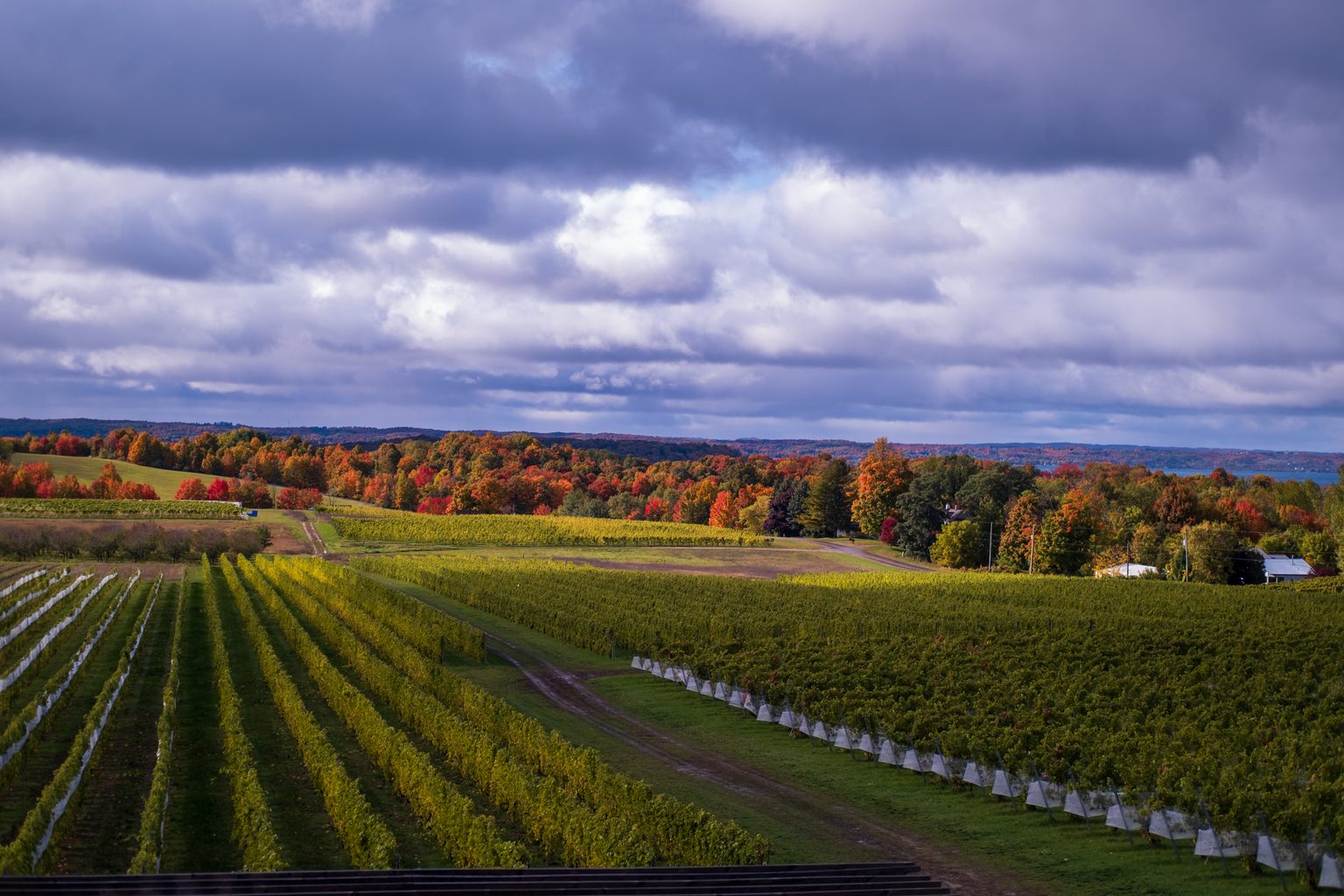
The 45th parallel has long been a marker of prestige in the wine world, threading through Bordeaux, Piedmont, and the established wine corridors of Europe. Now it cuts directly through northwest Michigan—and the Traverse Wine Coast is demonstrating competitive advantages that merit serious consideration from food and beverage decision-makers seeking market differentiation.
The region encompasses the wineries of the Leelanau and Old Mission Peninsulas, two distinct landmasses shaped by glacial movement and buffered by the deep, cold waters of Lake Michigan and Grand Traverse Bay. That geographic positioning—not coincidence—creates measurable advantages: the water moderates temperature, softens frost risk, and stretches the growing season just long enough for grapes to develop slow, even maturation that produces wines of real structure, bright acidity, concentrated aromatics, and balanced profiles that require no manufacturing.
Differentiated Sourcing: Old Mission Peninsula
Old Mission Peninsula, a 19-mile landmass flanked by water on both sides, has developed a reputation for consistent quality in varietal production. Well-drained sandy soils produce Cabernet Franc of surprising elegance, Gewurztraminer that leans floral without excess, and sparkling wines with the kind of tension that rewards shelf placement and margin. For beverage directors and purchasing teams, the peninsula represents a supply story distinct from established West Coast narratives.
Scale and Complexity: Leelanau Peninsula
The Leelanau Peninsula's rolling topography and glacial soils deliver Riesling capable of challenging established European benchmarks, alongside Chardonnay and Pinot Noir that earn comparison to cooler-climate Burgundy through inherent land characteristics rather than imitation. Winery farm stays and agritourism infrastructure here create complementary revenue opportunities for hospitality operators and destination developers.
Market Position and Accessibility
The Traverse Wine Coast operates from a strategic position: proximity to major markets, with Chicago within a five-hour drive and over twenty direct flights connecting the region to major cities. The accessibility, combined with limited saturation in national distribution channels, positions the region as a growth opportunity for beverage programs seeking to establish early-mover advantage.
This August, the region hosts the second annual Traverse City Food & Wine Event, drawing James Beard-recognized chefs and the wines of both peninsulas across farm settings. For hospitality operators and event professionals, the programming demonstrates how the region is building institutional support for its wine positioning.
Most wineries offer direct shipping, creating a pathway for B2B operators to establish direct relationships with producers. The region's reputation remains emerging relative to Napa or Sonoma—established, mature markets with saturated distribution networks and premium-price positioning. Traverse Wine Coast is still developing its market story, which presents a window for distributors, restaurant groups, and beverage programs to build relationships and positioning before broader market awareness arrives.
For decision-makers evaluating regional sourcing strategies and destination partnerships, the 45th parallel running through northwest Michigan represents an opportunity to establish differentiated positioning while supply and relationship dynamics remain favorable.
Traverse Wine Coast spans the Leelanau and Old Mission Peninsulas in northwest Michigan. For planning information, visit traversecity.com/traverse-wine-coast.